Section 2 Plans
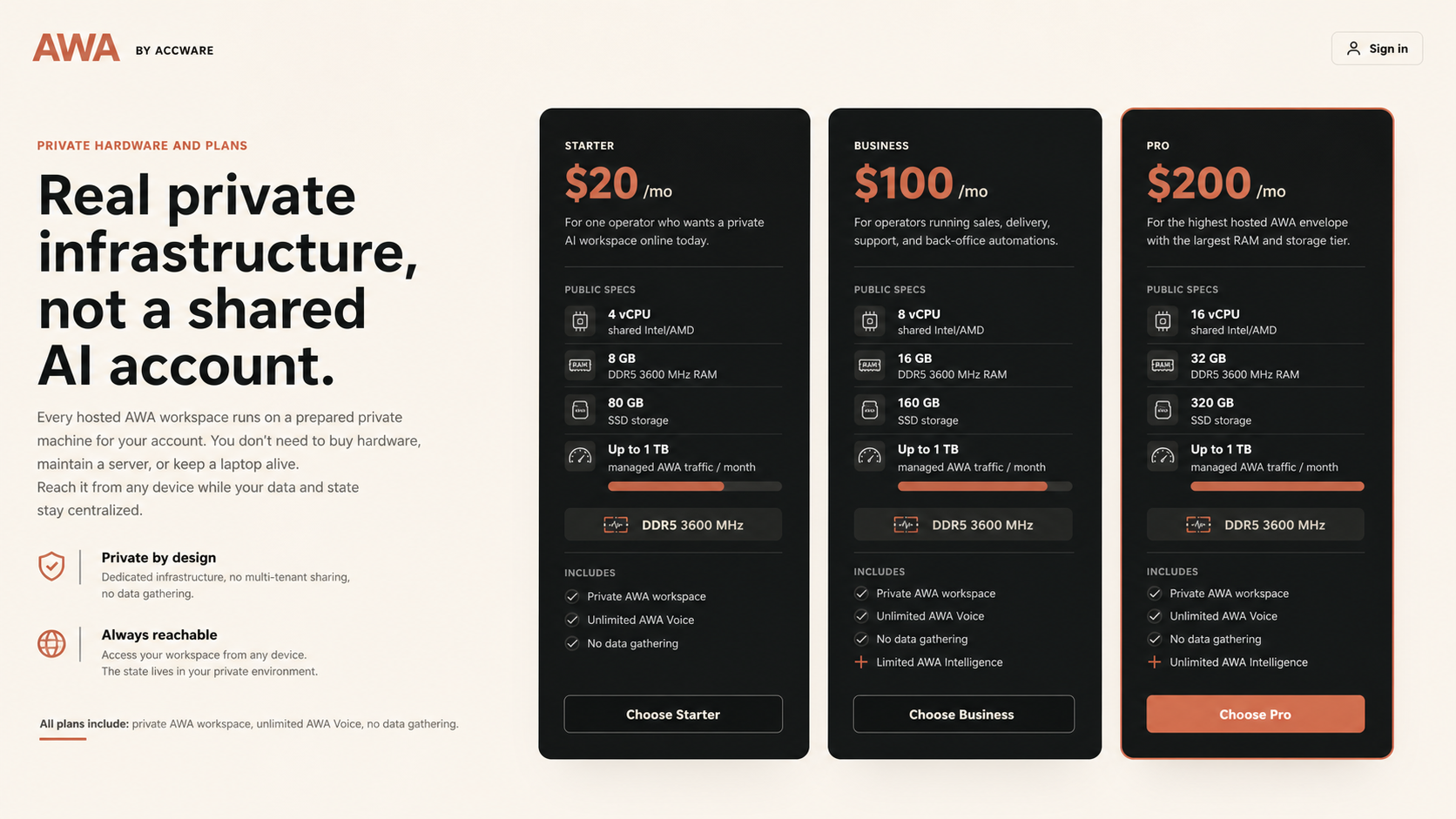
Keep the current plan cards, public-safe specs, AWA LLM access levels, BYO agent harness, and responsive fit.
AWA by Accware
This is the public render library for the production rebuild. Section 2 Plans is the only validated direction. Every other section is invalidated or deferred until a new operator-approved direction exists. Images remain references only: final copy, logo, routes, animations, accessibility, and responsive behavior must be rebuilt in deterministic HTML/CSS.
Validation board
This board is the handoff for the next implementation worker. Section 2 is approved. Sections 1, 3, 4, 5, 6, 7, and 9 are invalidated. Section 8 is deferred until a real system screenshot is available.
Keep the current plan cards, public-safe specs, AWA LLM access levels, BYO agent harness, and responsive fit.
Use their images only as partial references. They are not approved as final visual, motion, or implementation directions.
Do not implement or regenerate it yet. Wait for an actual screenshot of the real system before designing the memory graph.
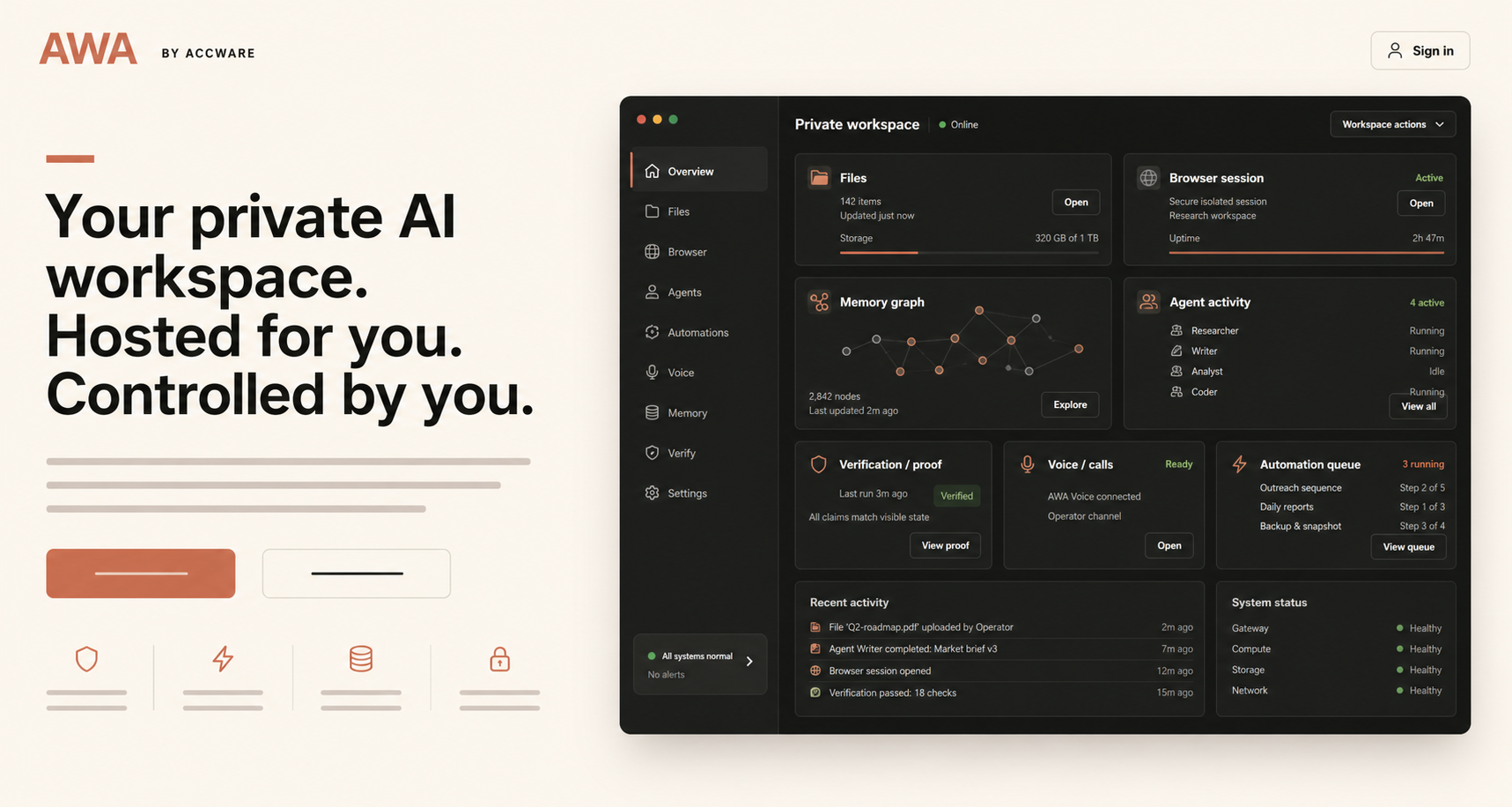
Historical framing only. Rebuild after Section 2 quality bar with exact header, no form, and deterministic AWA workspace UI.
Current accepted baseline. Preserve the plan copy, public specs, AWA LLM access levels, BYO agent harness, Pro distinction, and responsive fit.
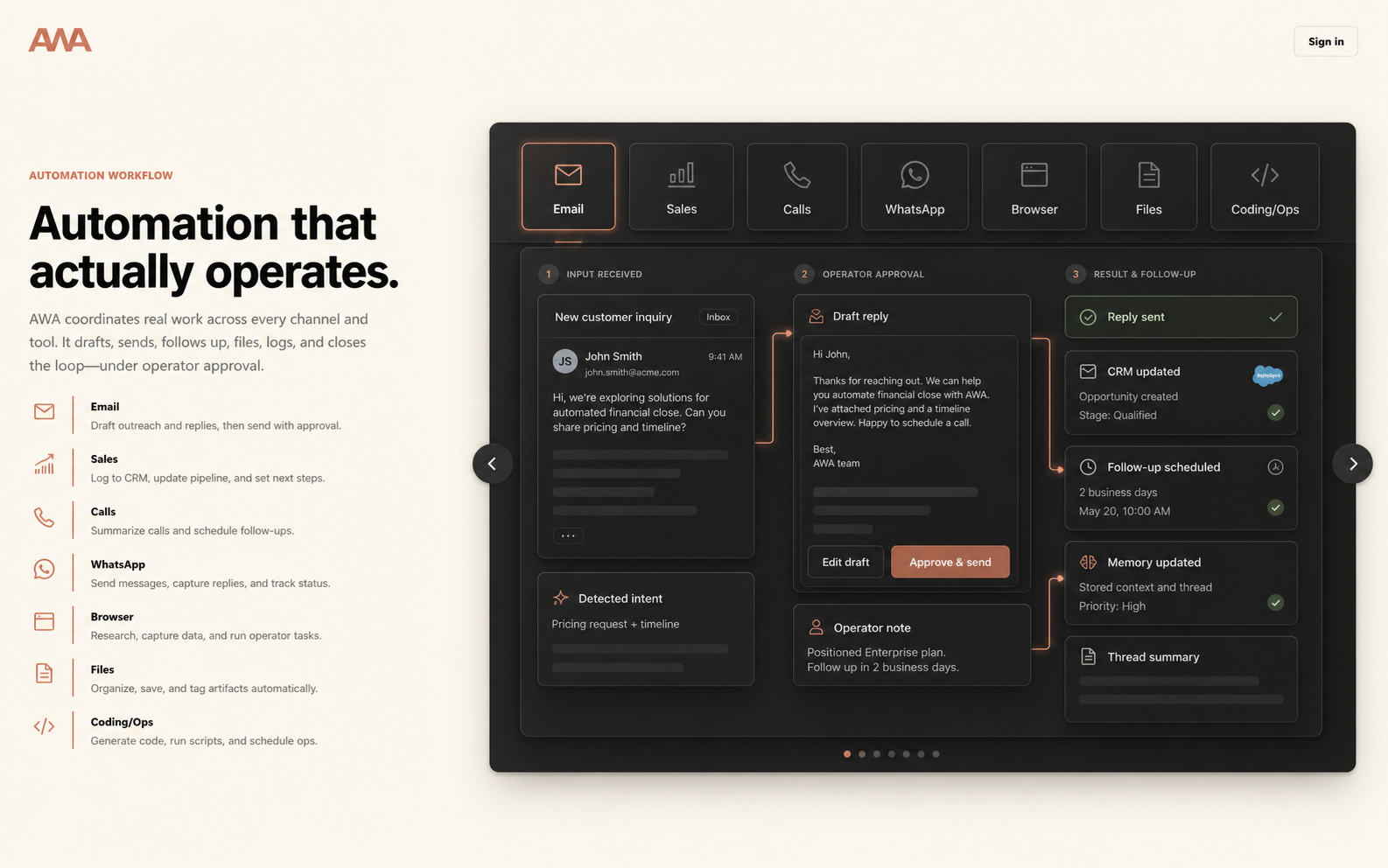
Needs eight distinct product scenes, not a generic carousel template. Email, Sales, Calls, WhatsApp, Browser, Files, Coding, and Ops each need a real workflow.
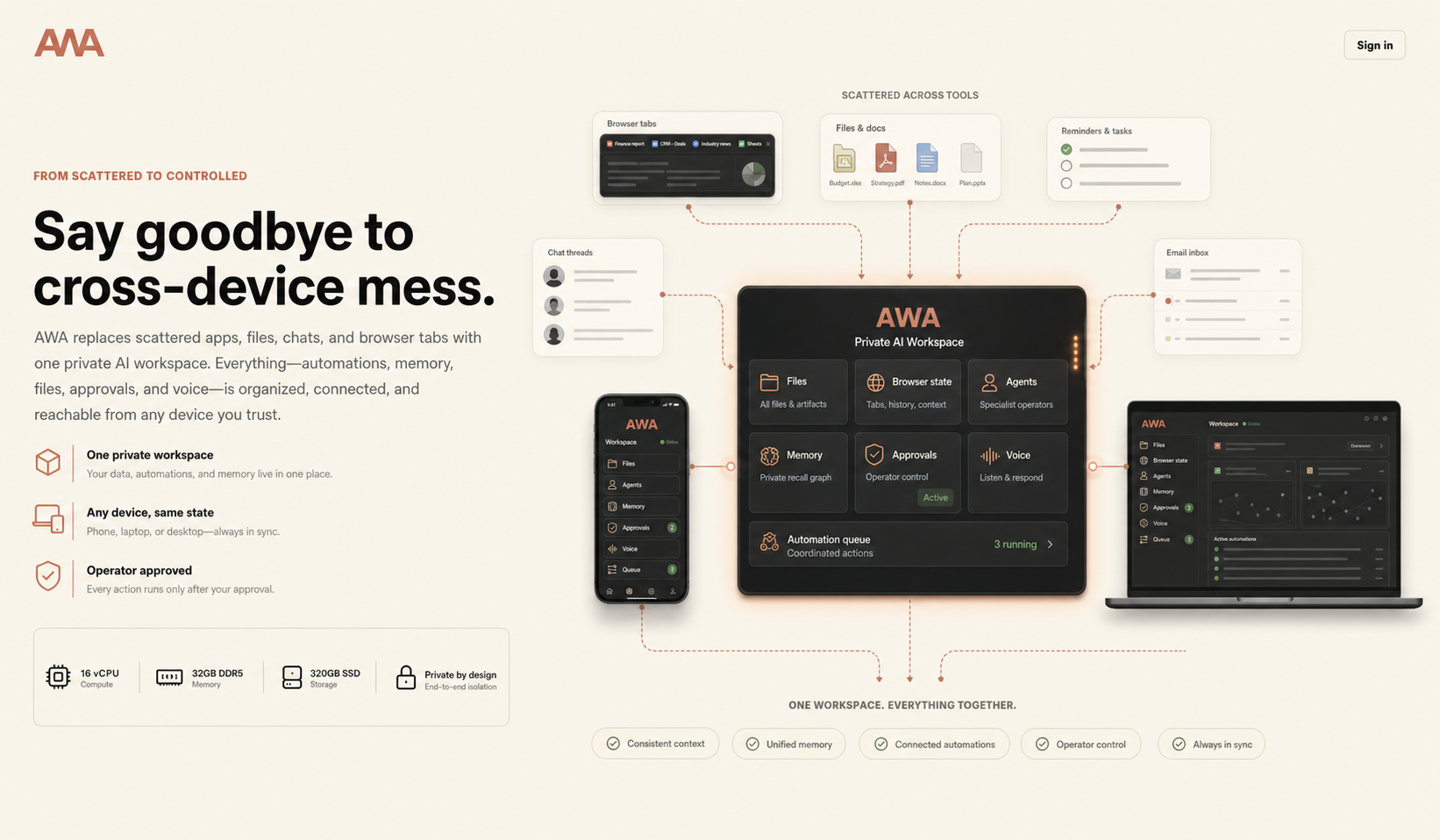
Good inspiration, but upgrade it: clearer convergence, stronger premium product surface, less dashboard language, and better device-to-workspace story.
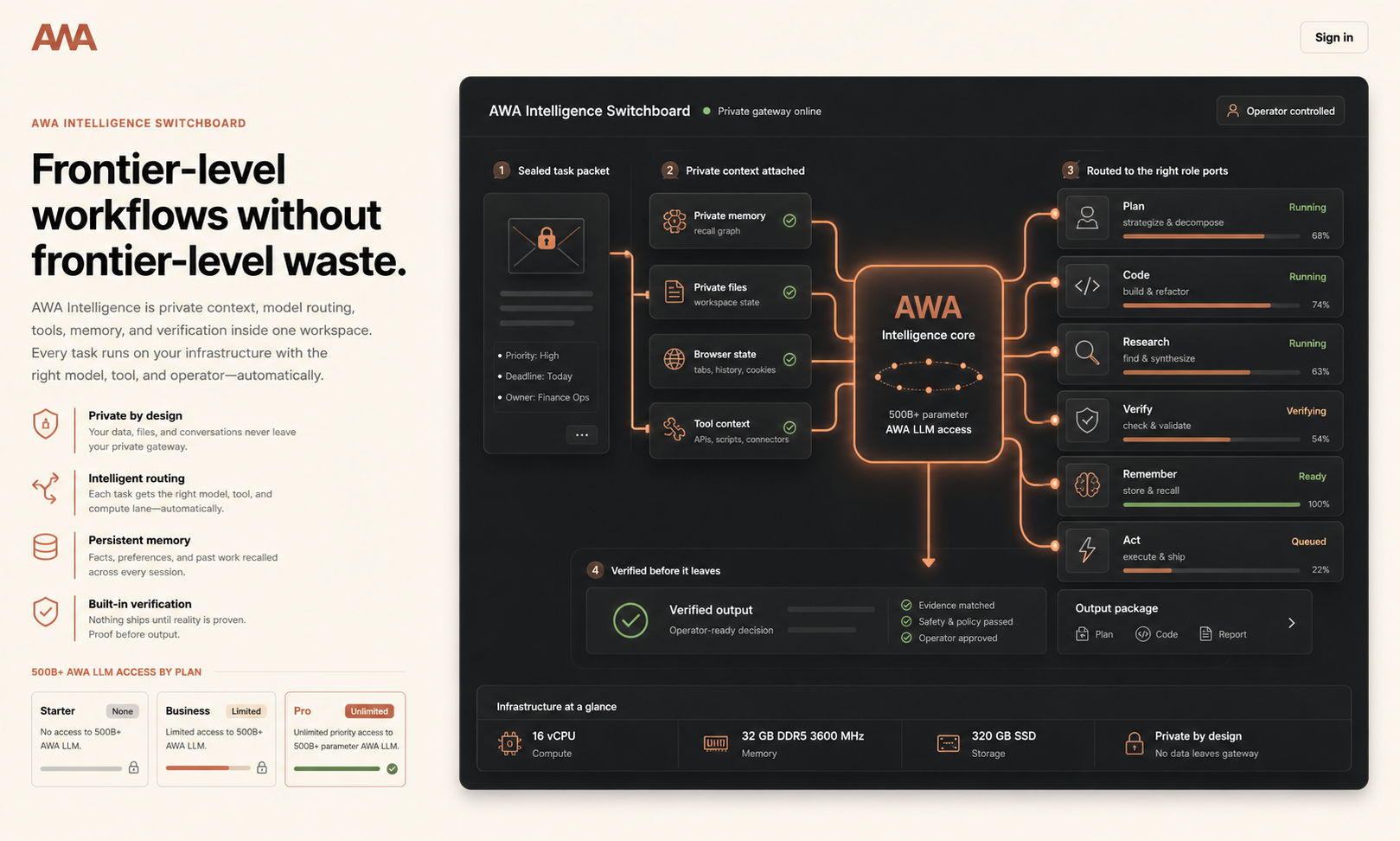
Direction only. Must become more minimalist, less render-heavy, and much stronger on the right-side AWA Intelligence product mechanism.
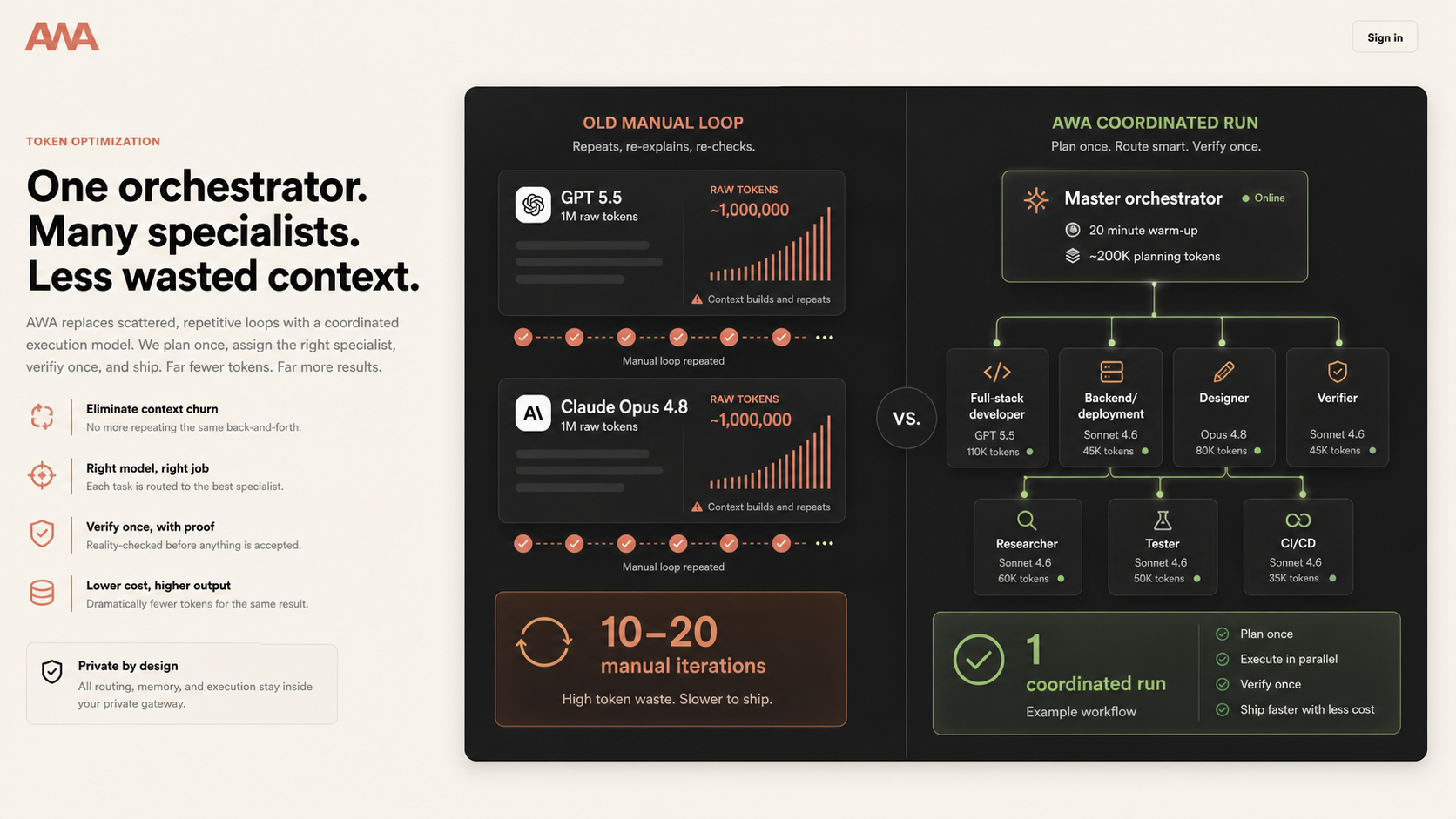
Too unclear. Rebuild the right side as a coordinated dispatch tree with Fable 5, GPT 5.6 Solana, GPT 5.6 Tera, Luna, AWA Intelligence, and AWA Pinocchio verifier harness.
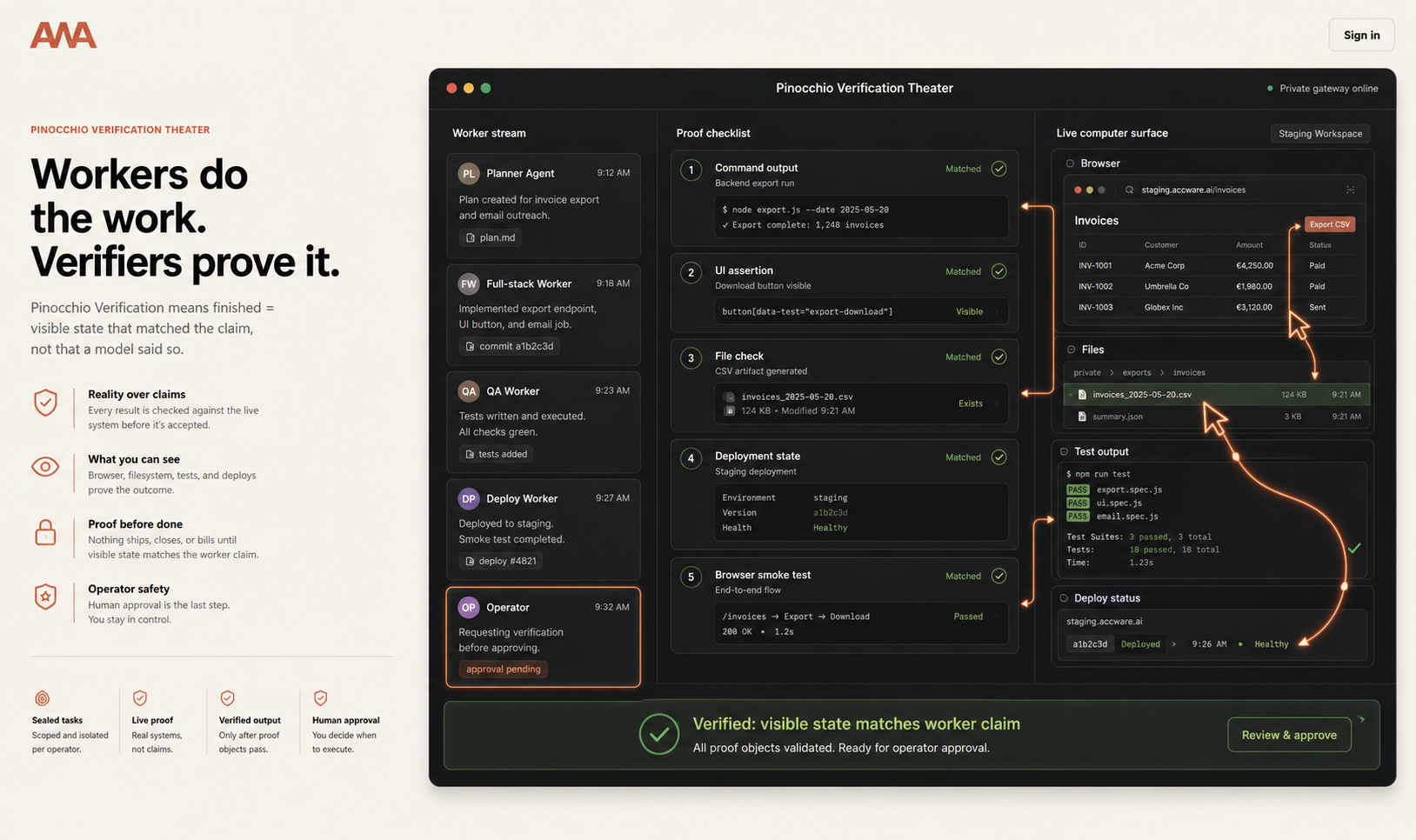
Keep the theater idea, but replace orange/static proof dots with a real simulated verification run: cursor moves, evidence appears, badge lights after proof.
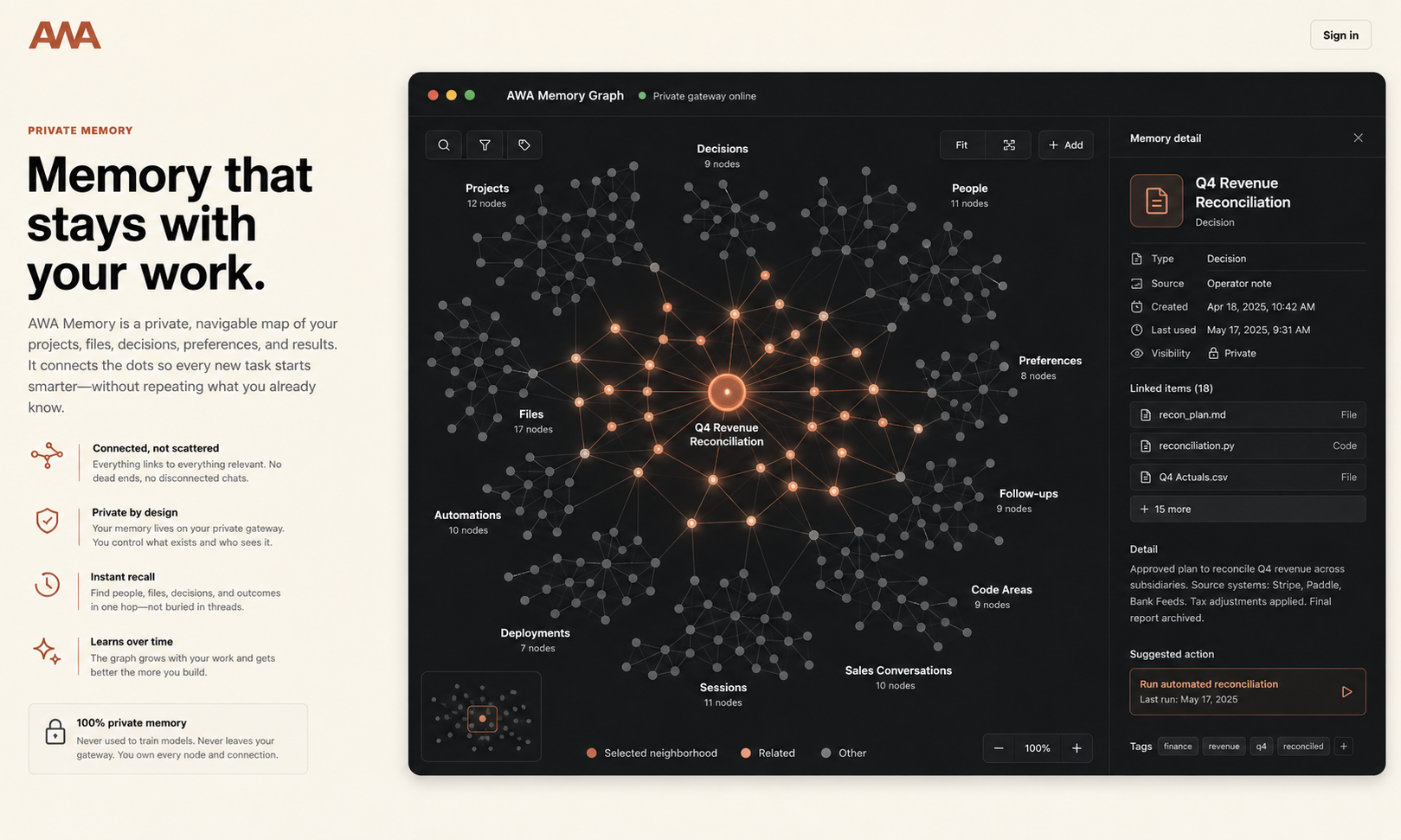
Do not build yet. Wait for an actual screenshot of the real system, then design the Obsidian-like memory graph from that evidence.
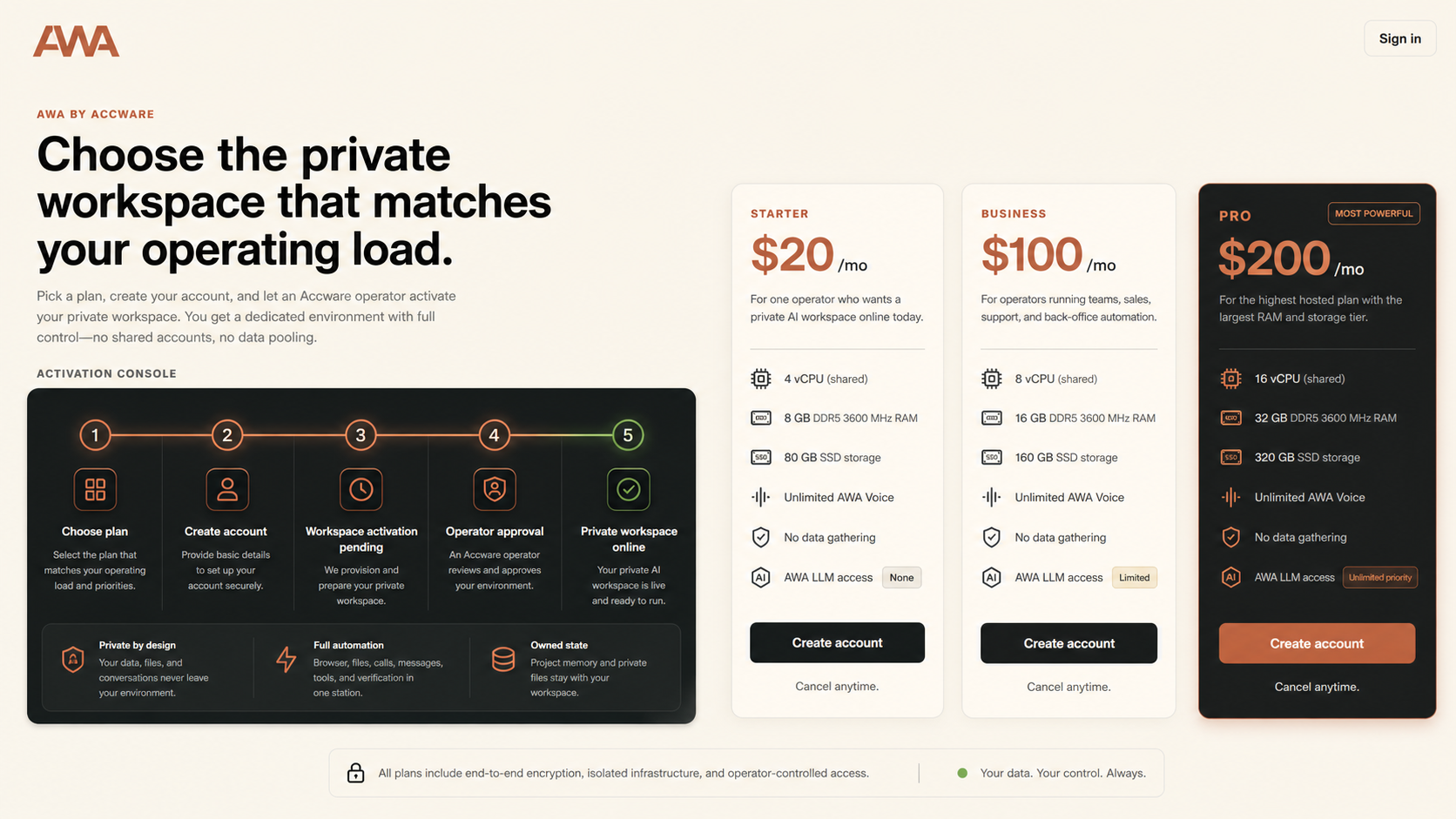
Do not repeat pricing cards. Section 2 already owns plans. Find a fresh activation/account handoff concept before implementation.
Section 3 render lock
These eight renders are implementation references for the Section 3 carousel. They use the updated operator order: Email, Coding, Sales, Calls, WhatsApp, Browser, Files, Ops. They are not final HTML/CSS acceptance; deterministic implementation must rebuild labels, copy, motion, accessibility, and responsive behavior.
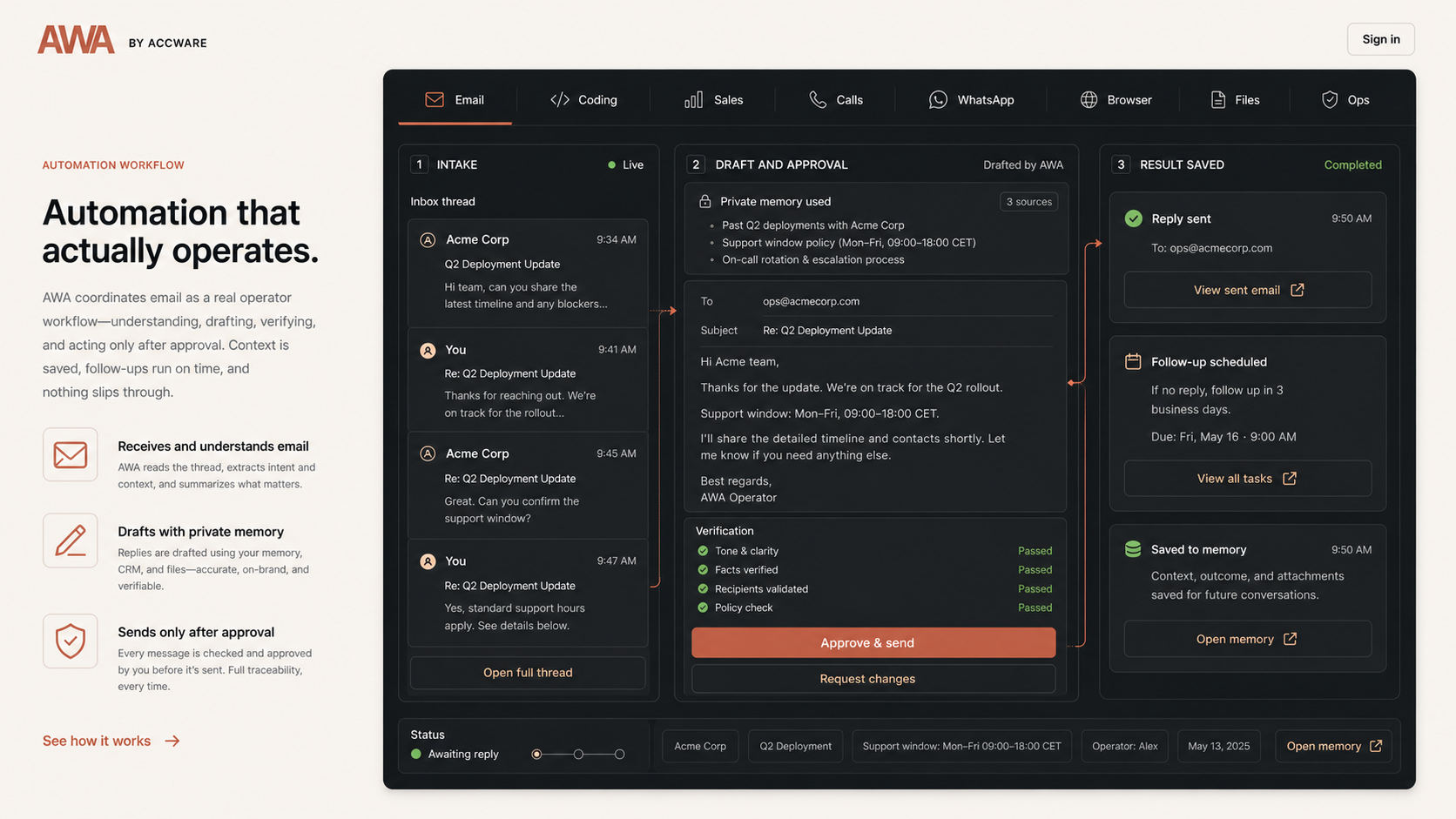
Intake, private-memory draft, verification, approval, reply sent, follow-up, and memory saved.
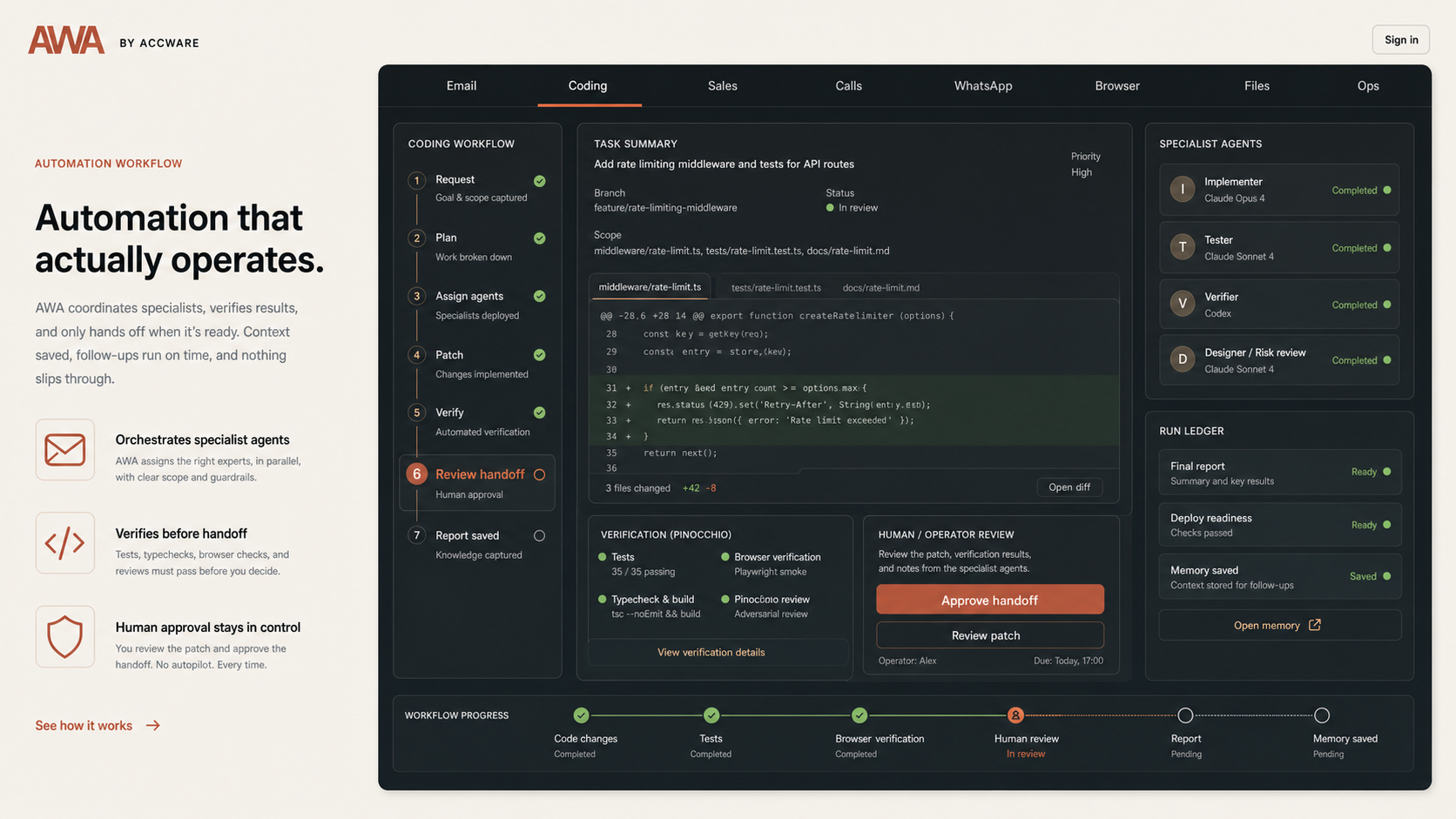
Orchestrator, specialist agents, code diff, tests, browser verification, Pinocchio review, human handoff, and memory.
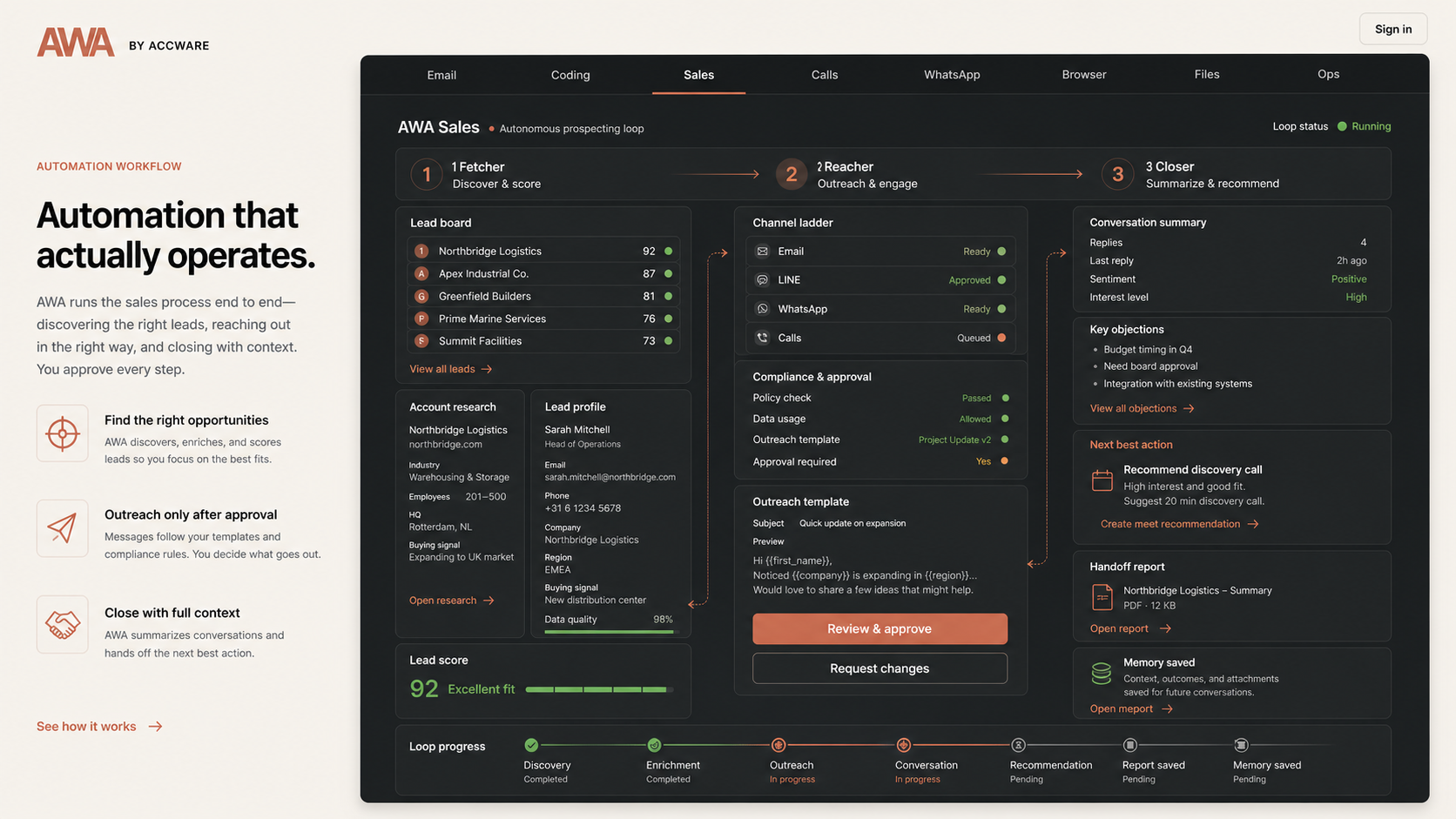
Fetcher, Reacher, and Closer across discovery, enrichment, outreach, objections, approval, and handoff report.
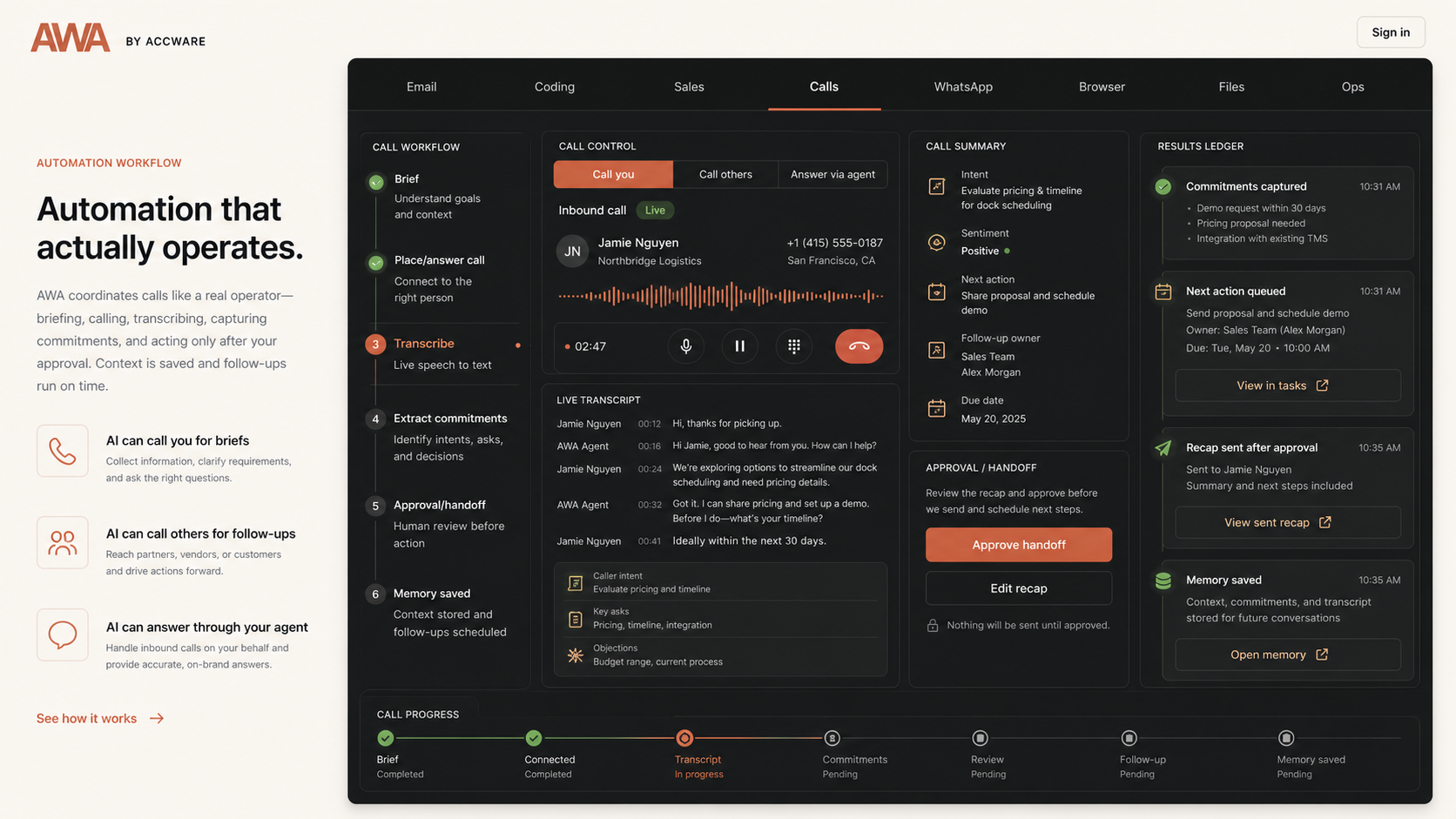
Brief, place or answer call, transcribe, extract commitments, approval handoff, follow-up, and memory.
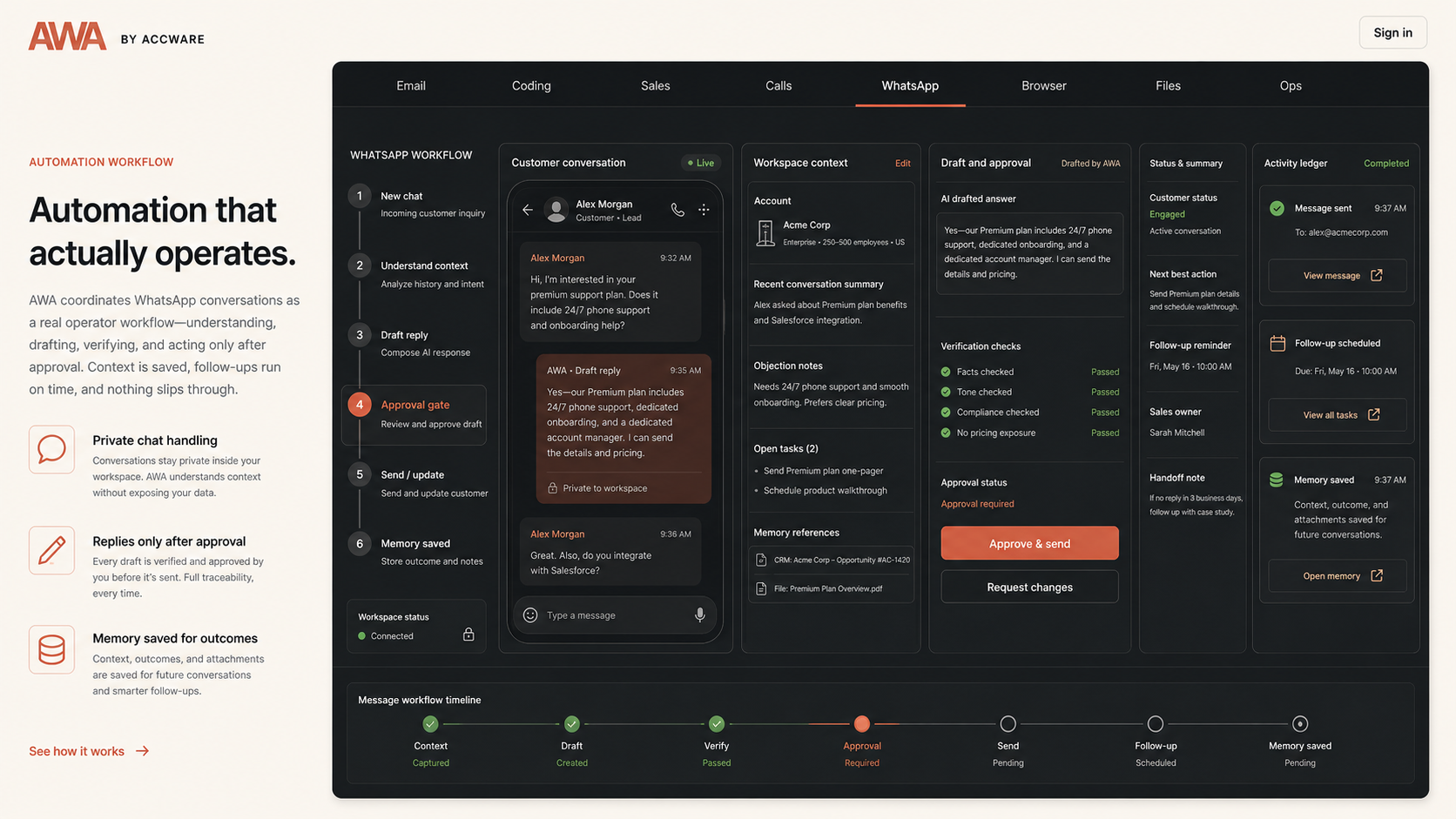
Customer chat, workspace context, draft and approval, status summary, activity ledger, and memory saved.
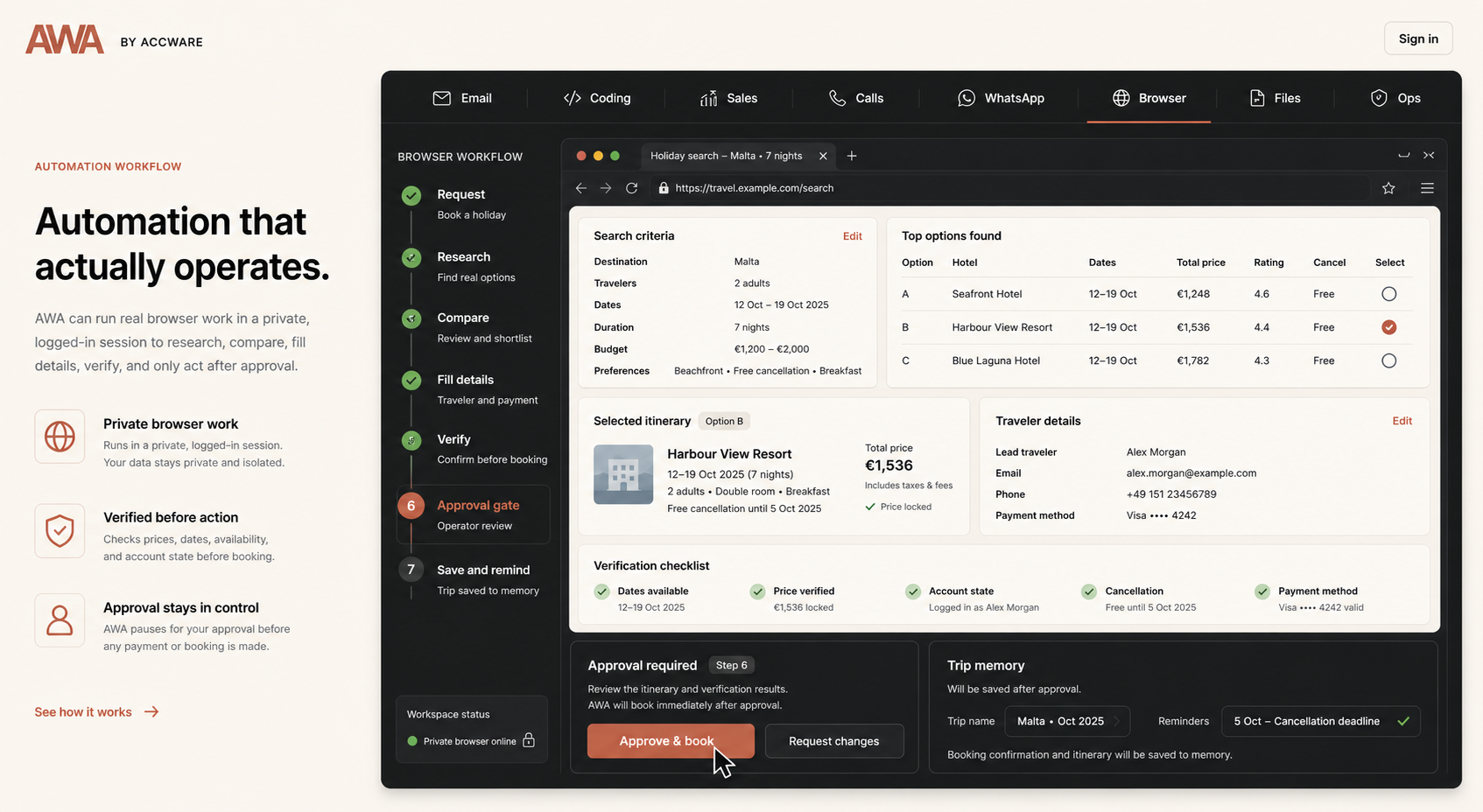
Book a holiday through private browser research, comparison, verification, approval gate, and trip memory.
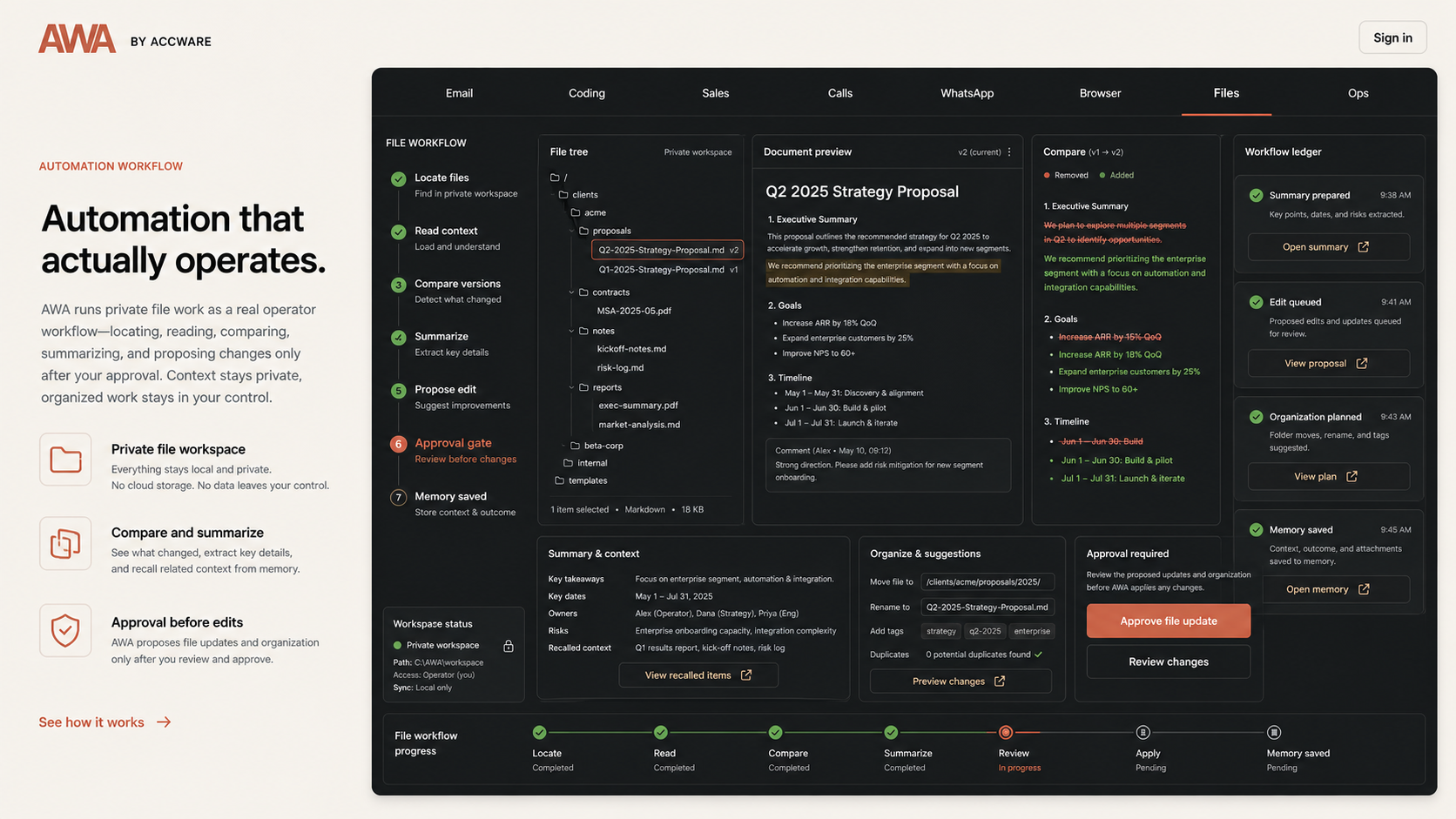
File tree, document preview, comparison, summary, organized suggestions, approval before edits, and memory.
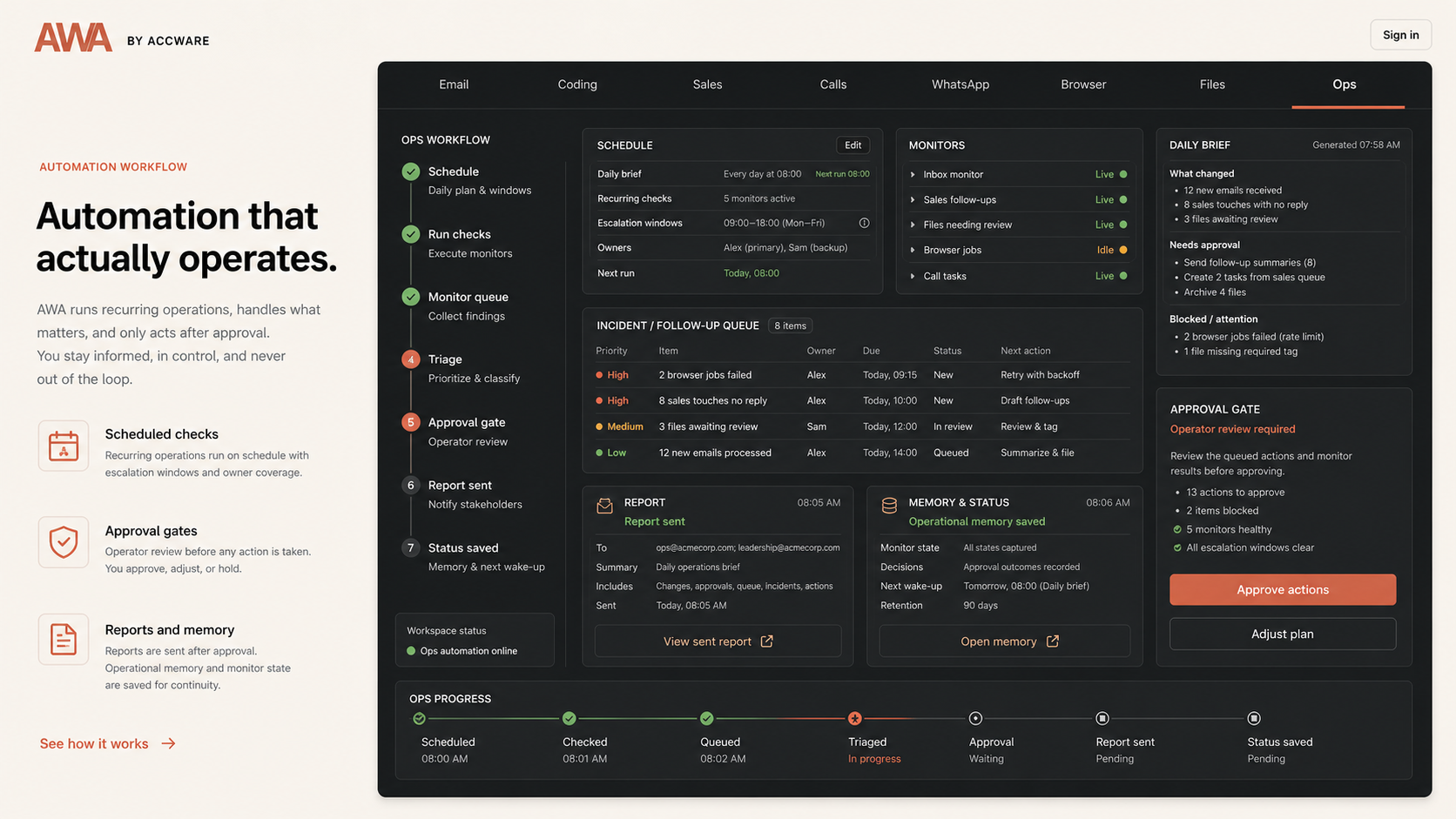
Schedules, monitors, daily brief, incident queue, approval gate, report sent, and operational memory.
Reference stack
This stack remains useful for broad rhythm only. It is not a validated production target except for Section 2. Do not use it to claim Sections 1, 3, 4, 5, 6, 7, 8, or 9 are accepted.
Lab
The lab is not the production target. Use it only for specific strengths called out here: scene density, mobile simplification, access meters, tree spacing, or proof ledger behavior.
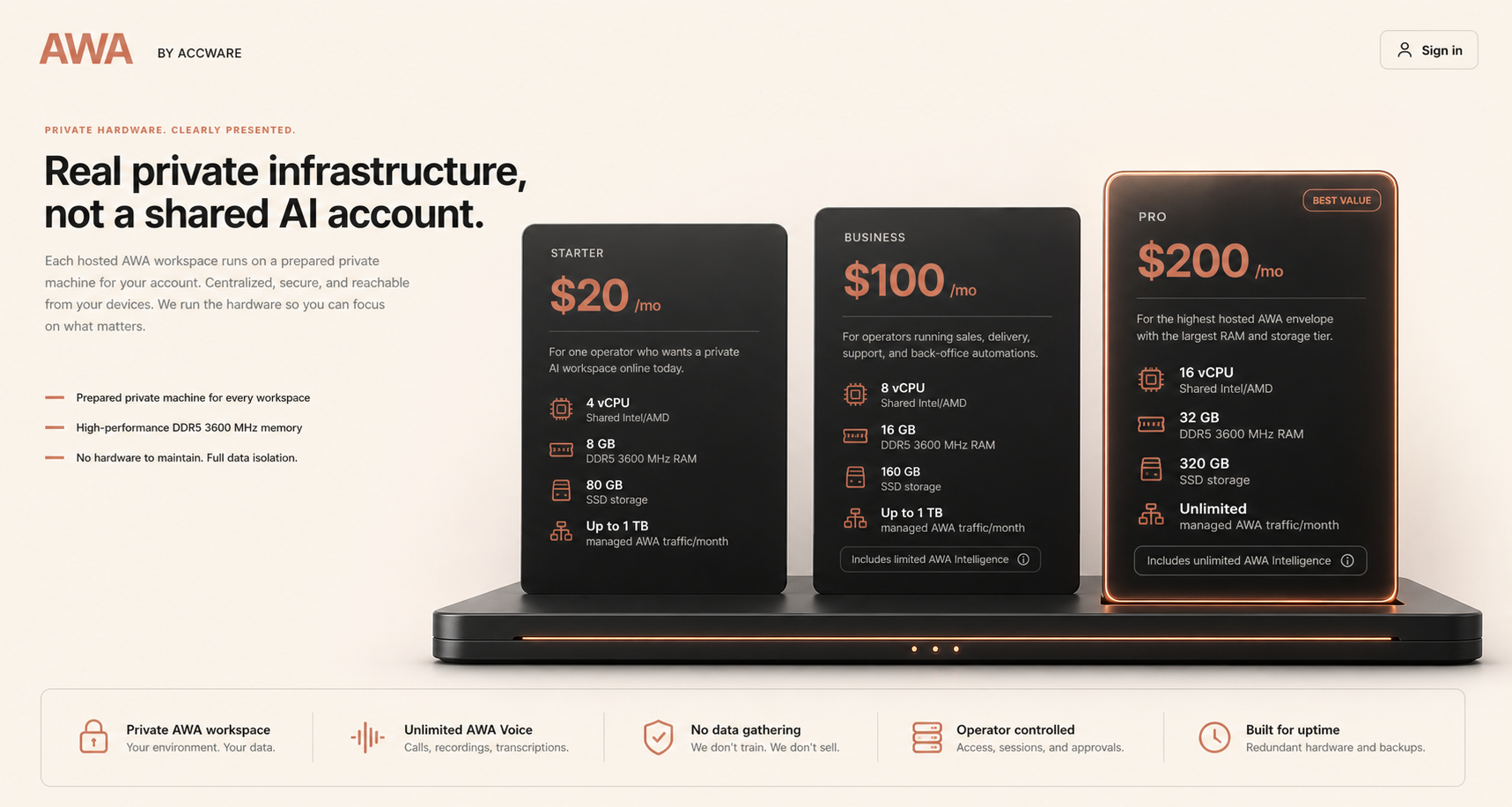
Useful product depth. Do not copy generated copy or traffic emphasis.
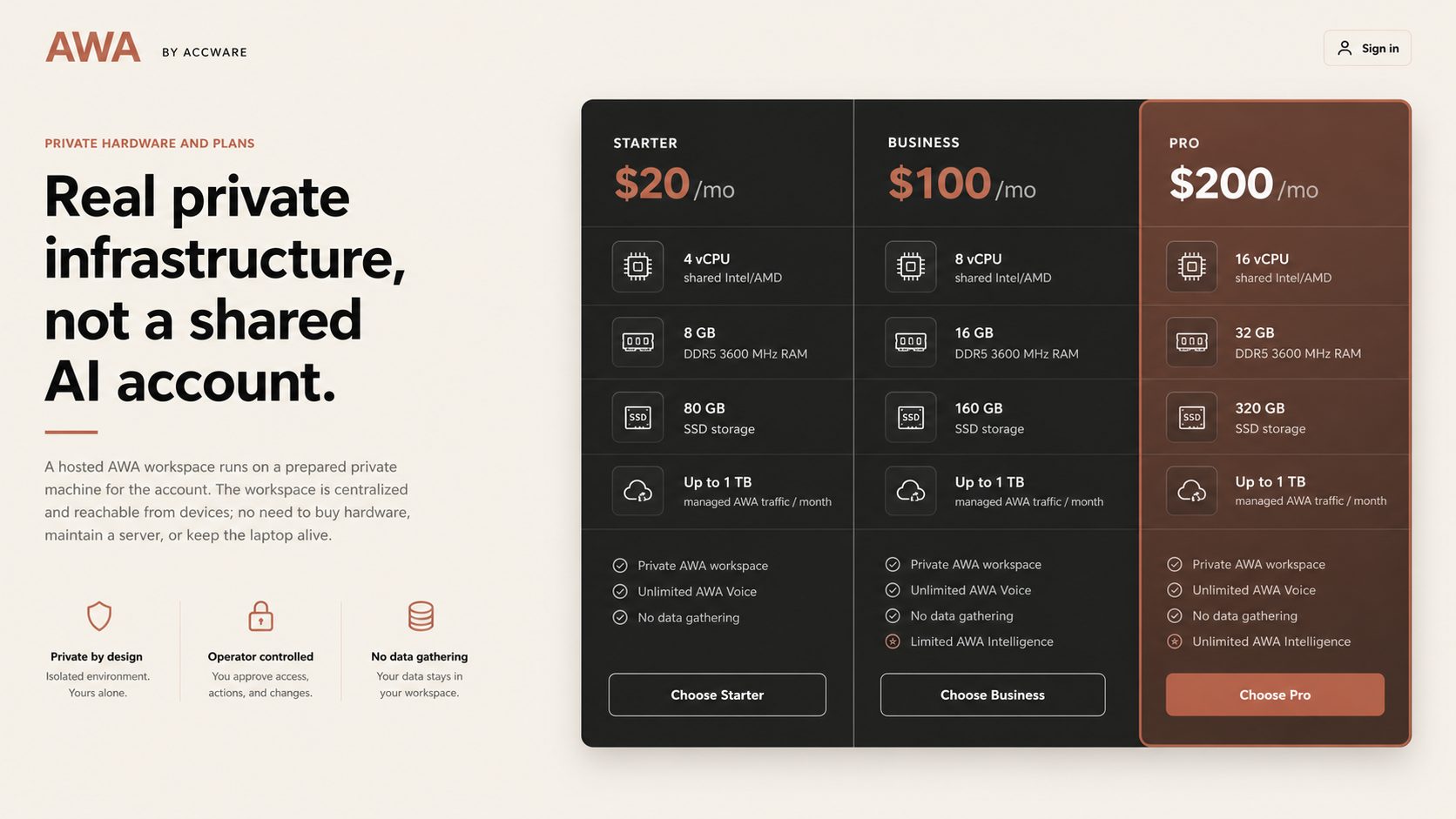
Useful for exact plan comparison and responsive table thinking.
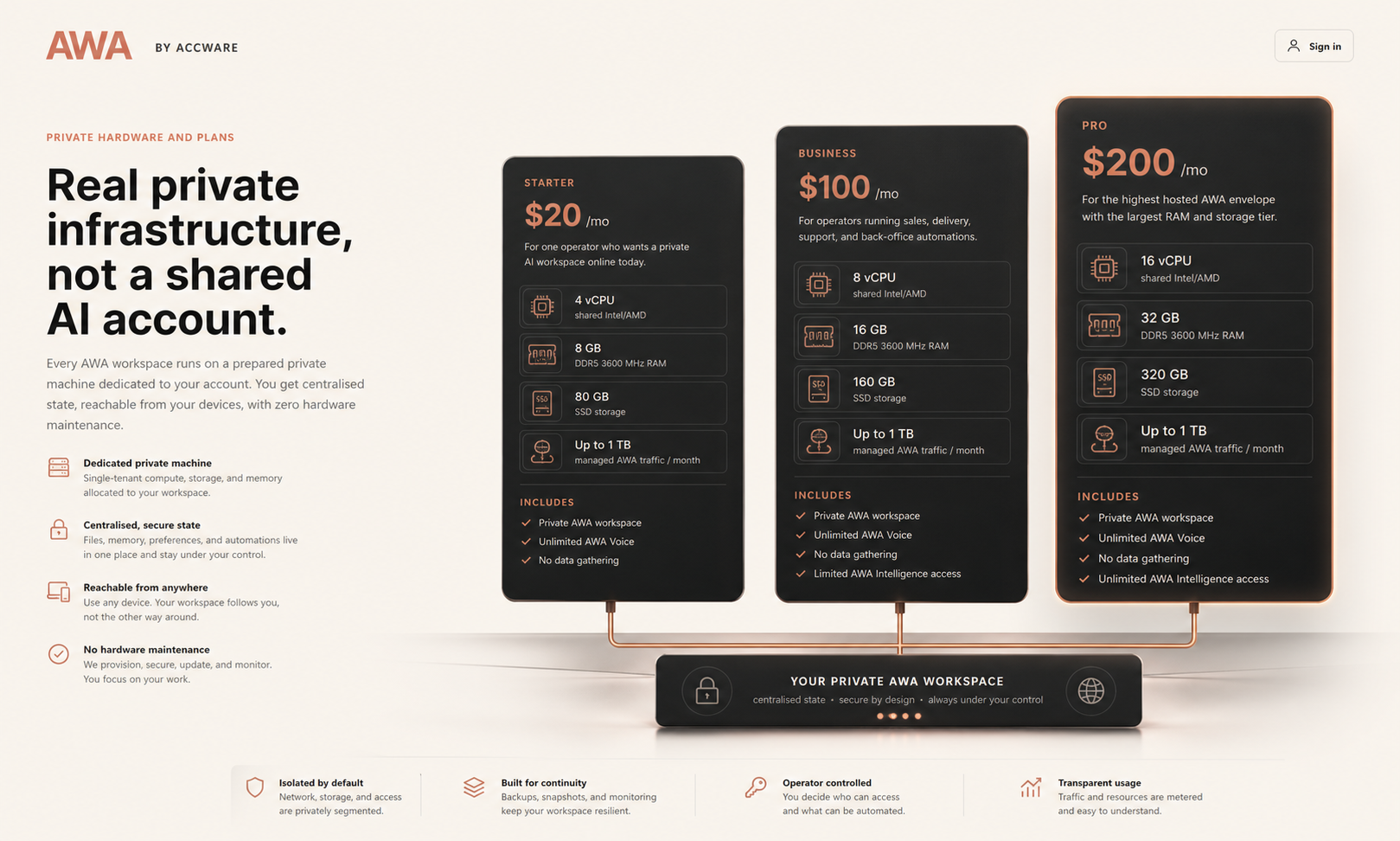
Borrow left-side identity and benefit rhythm, not layout complexity.
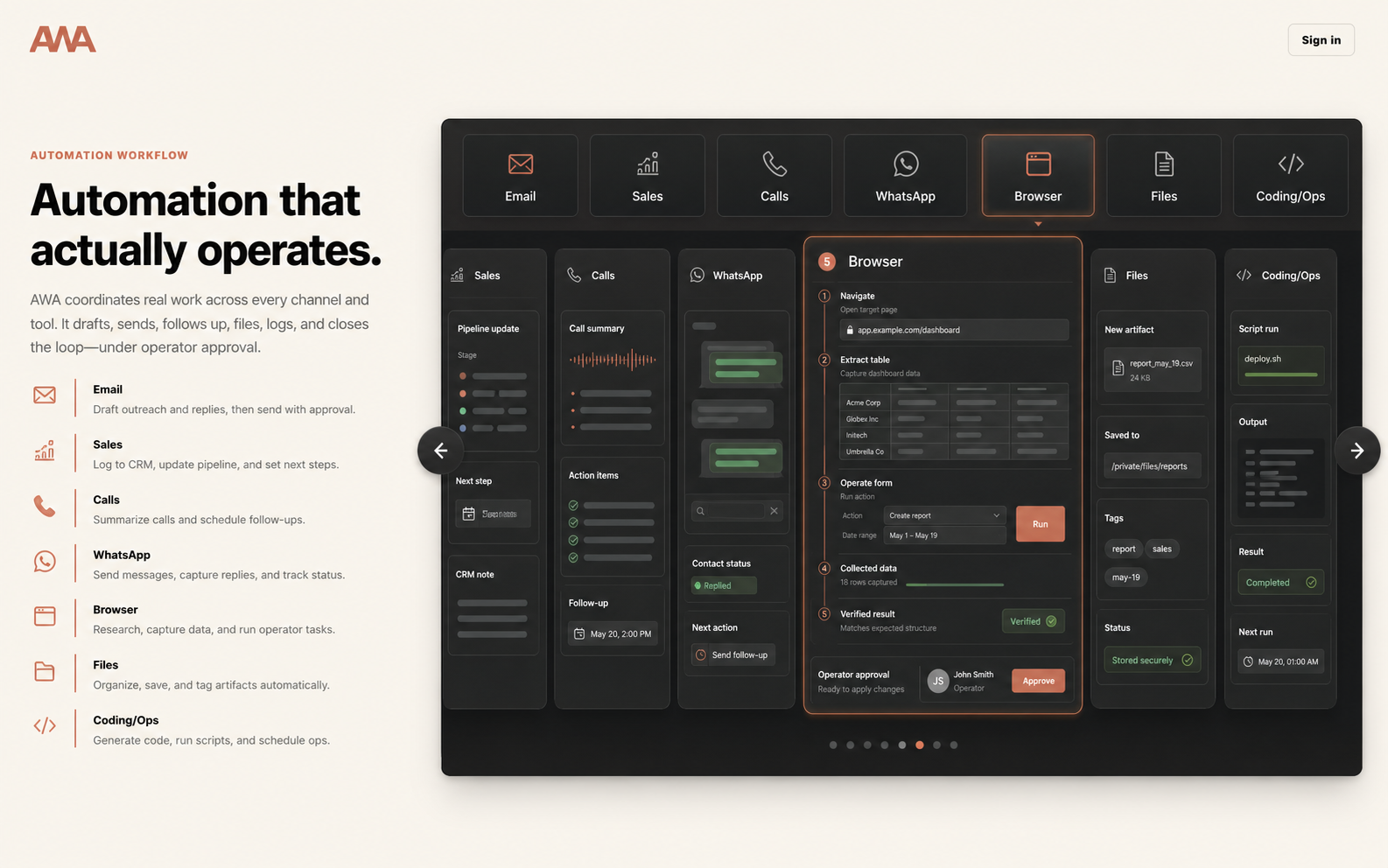
Use for Browser mode: tabs, table extraction, form run, verified result.
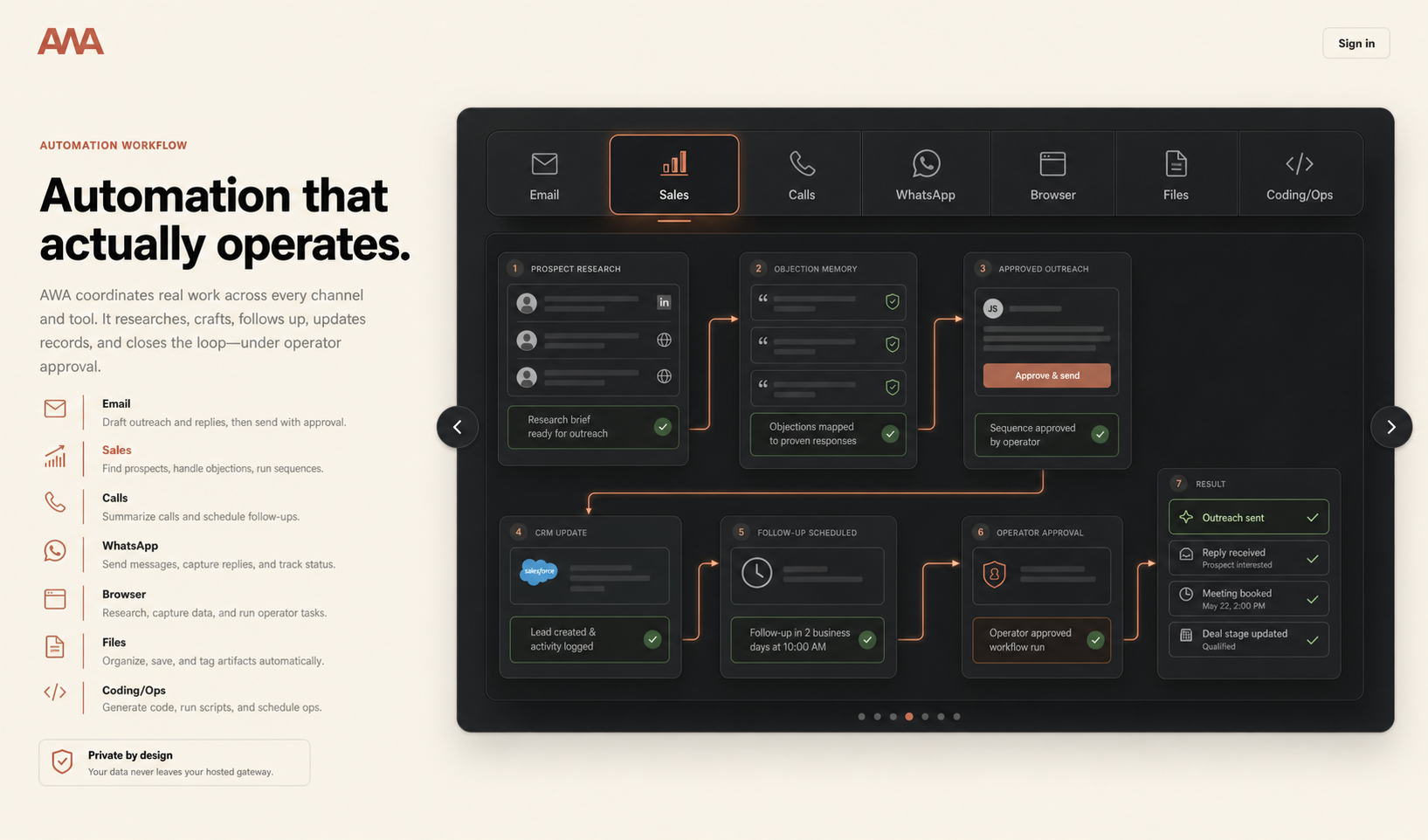
Use for prospect research, objections, outreach, CRM, follow-up sequence.
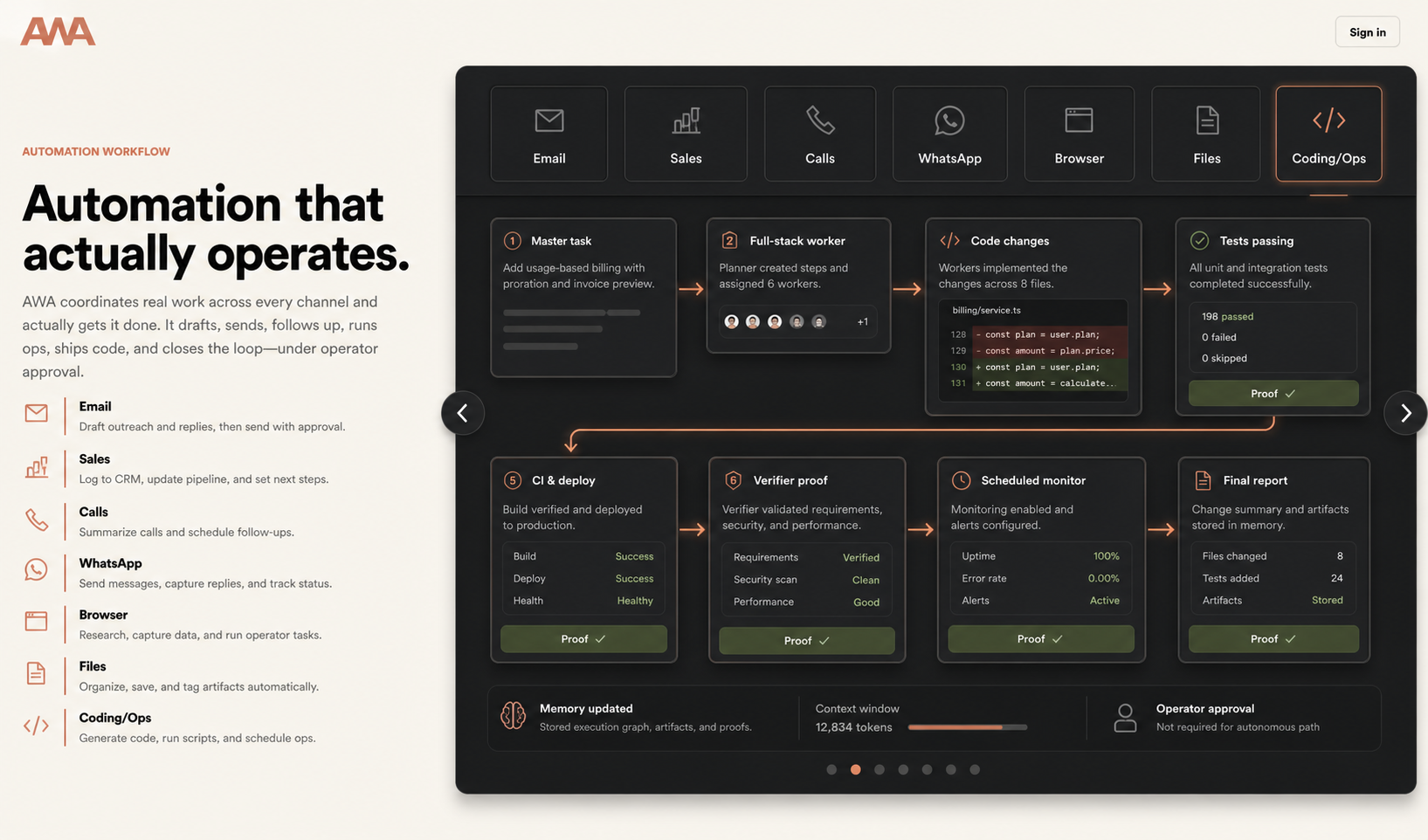
Use for code changes, tests, CI/deploy, verifier proof, scheduled monitor.
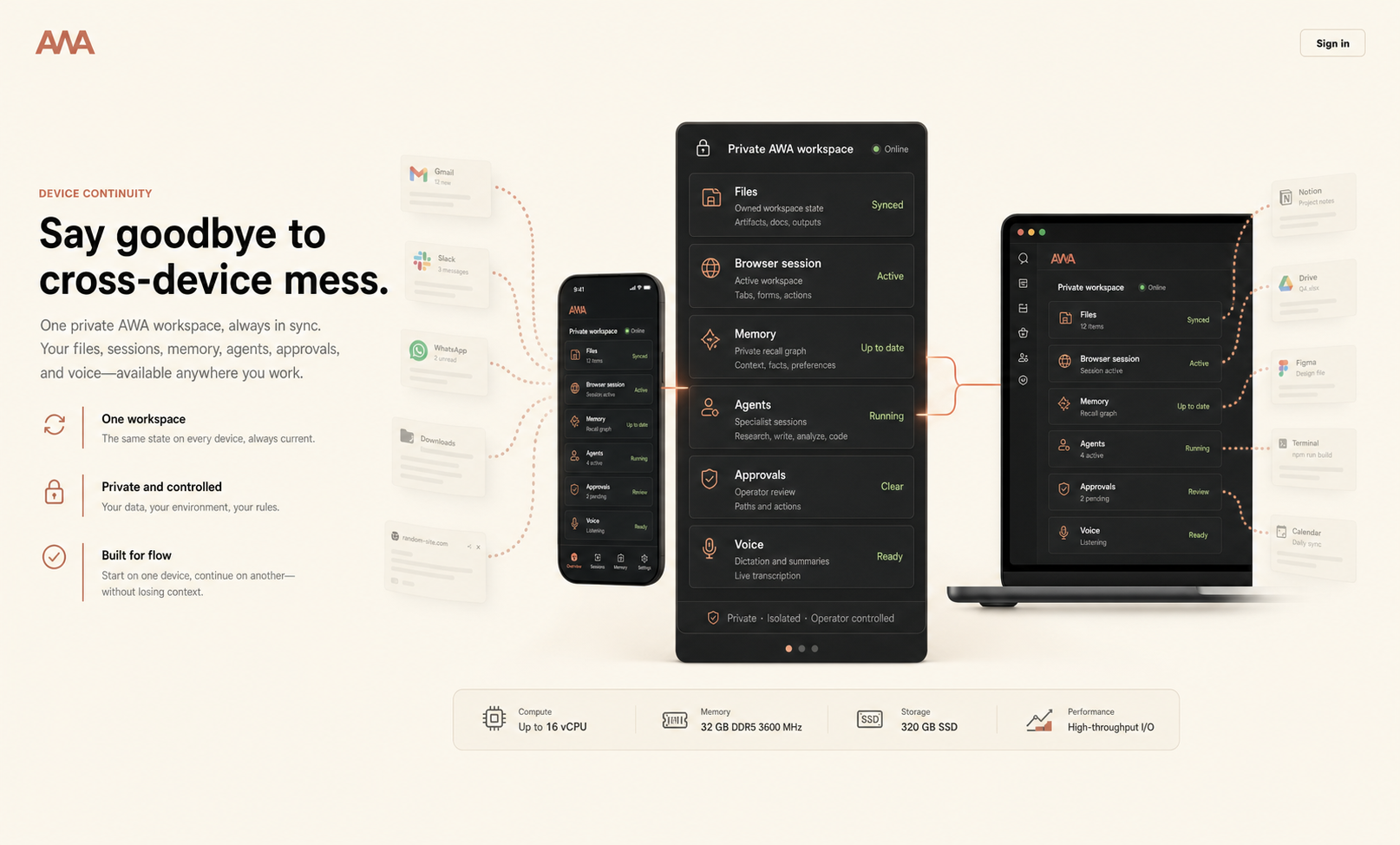
Good continuity concept, but generated app-logo fragments are too literal.
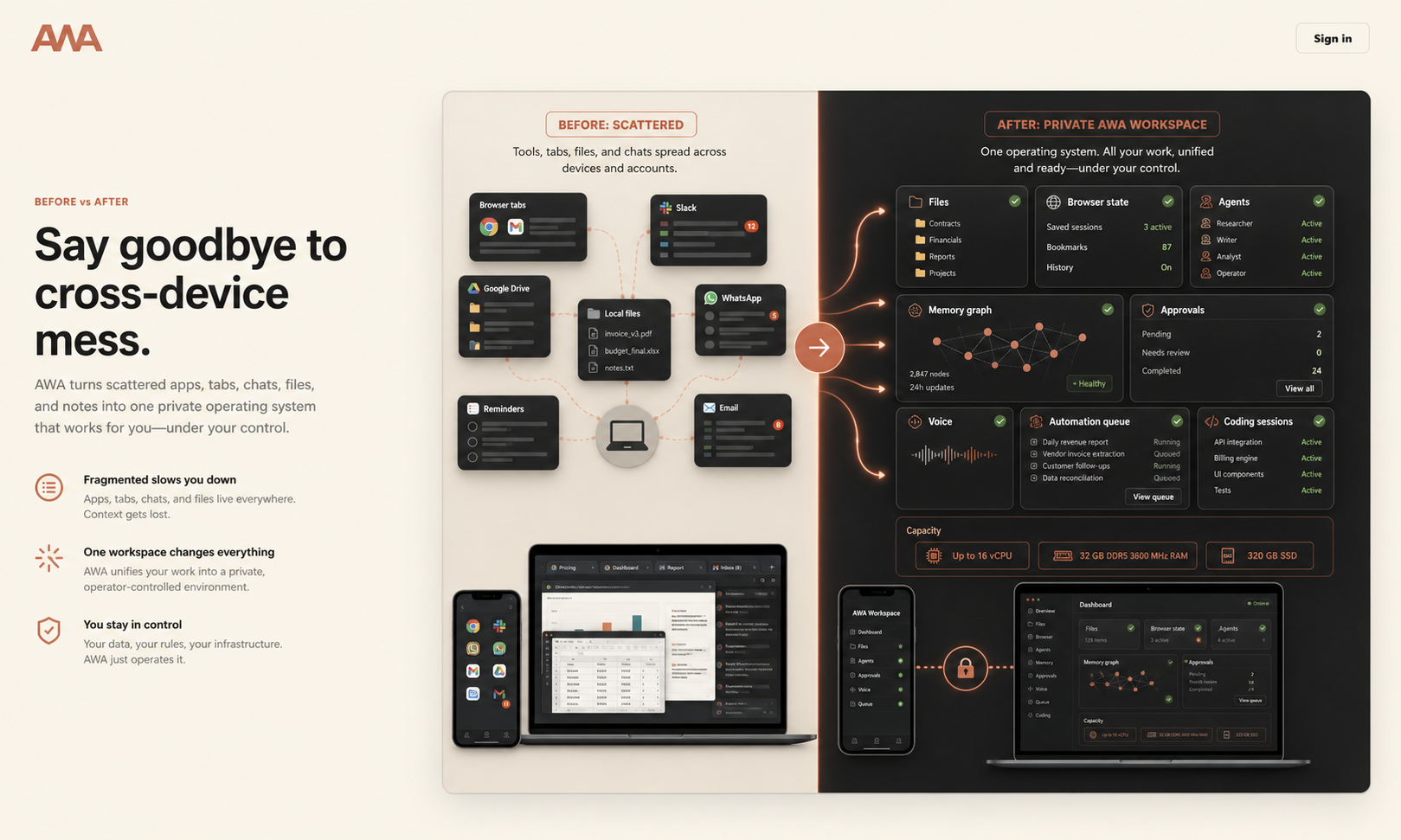
Clear transformation, but too crowded for the final selected direction.
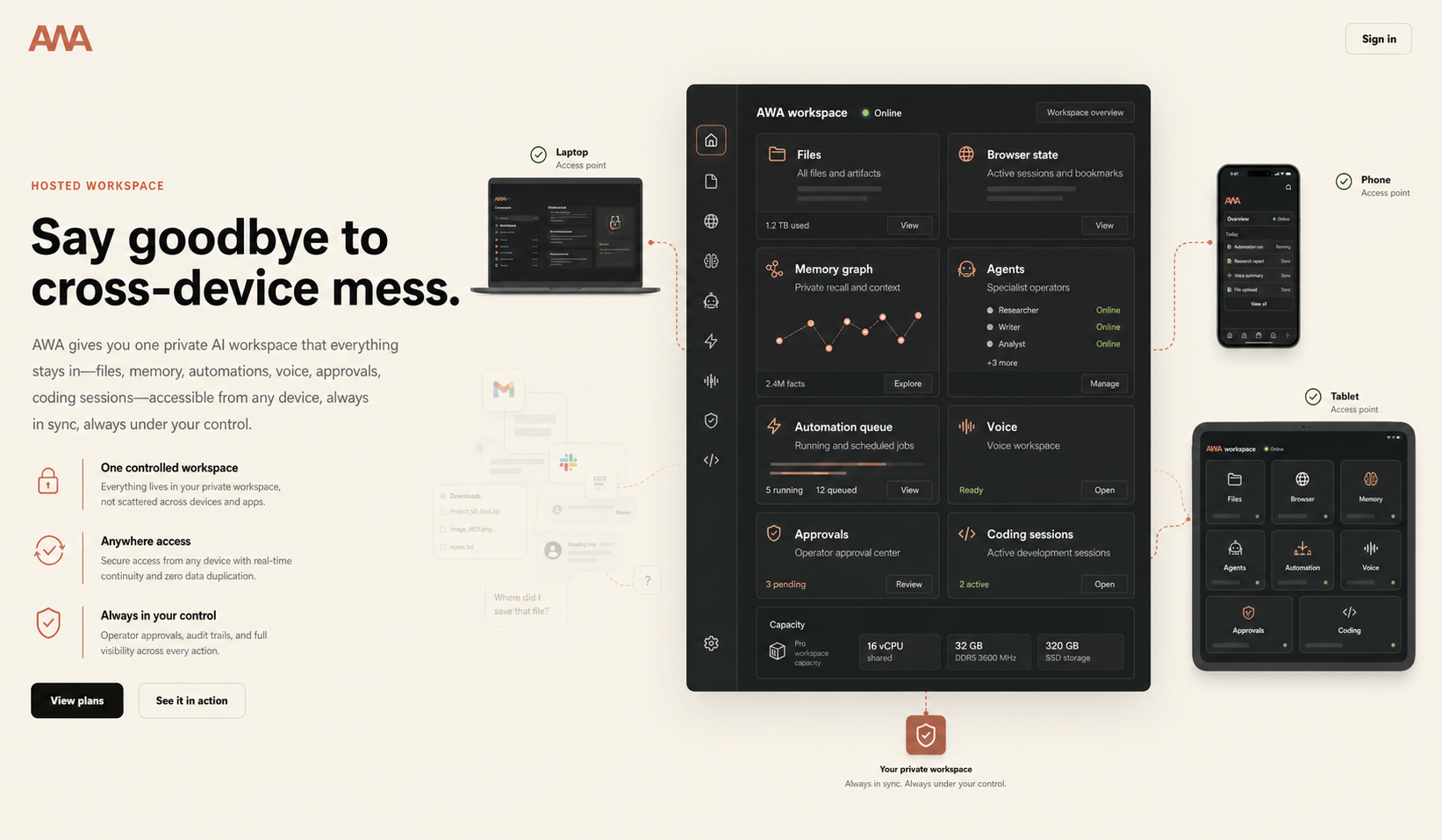
Use for central module detail if Section 4 feels too sparse.
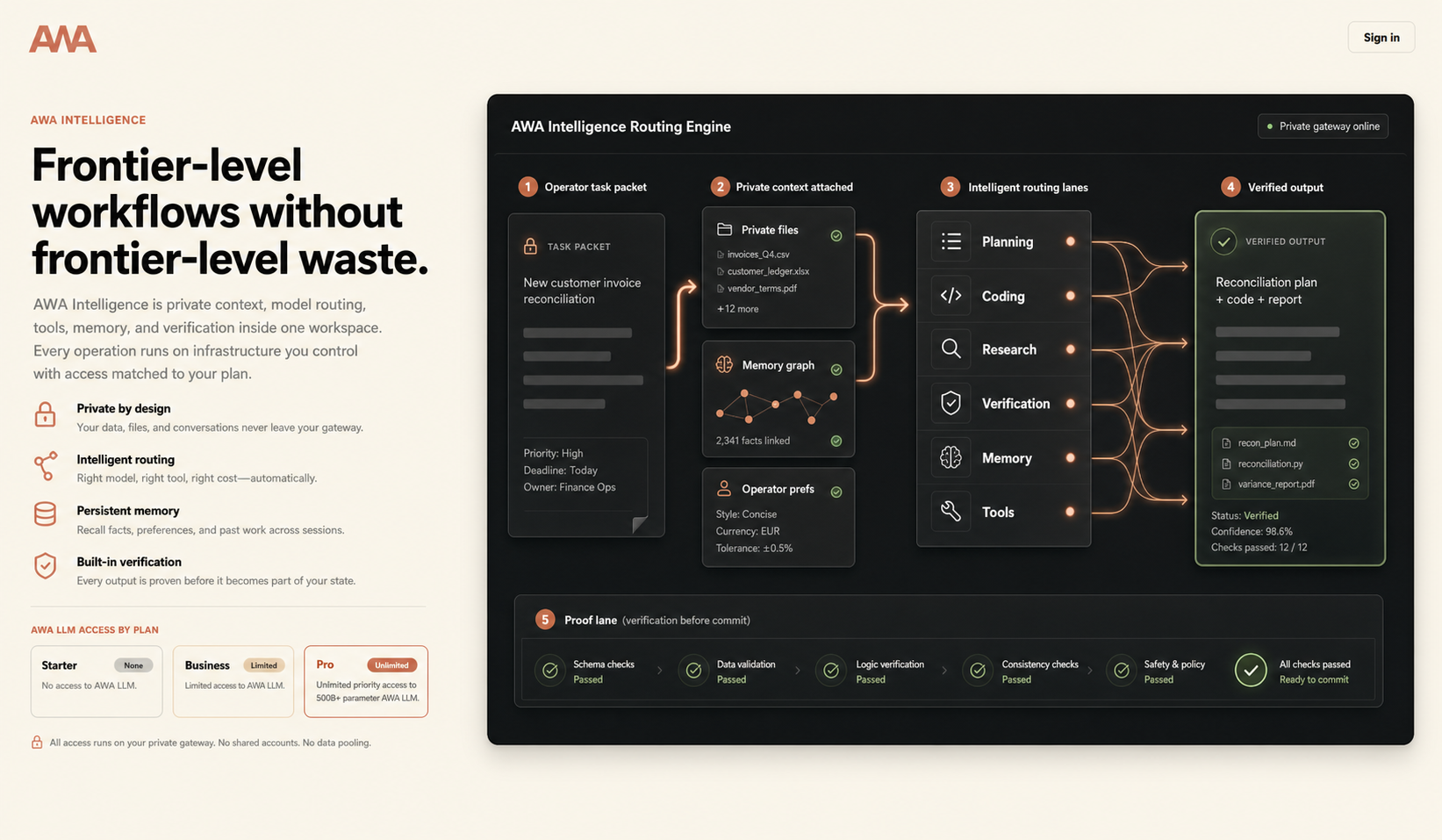
Only borrow proof-path structure. The final section needs a quieter, more credible AWA Intelligence mechanism.
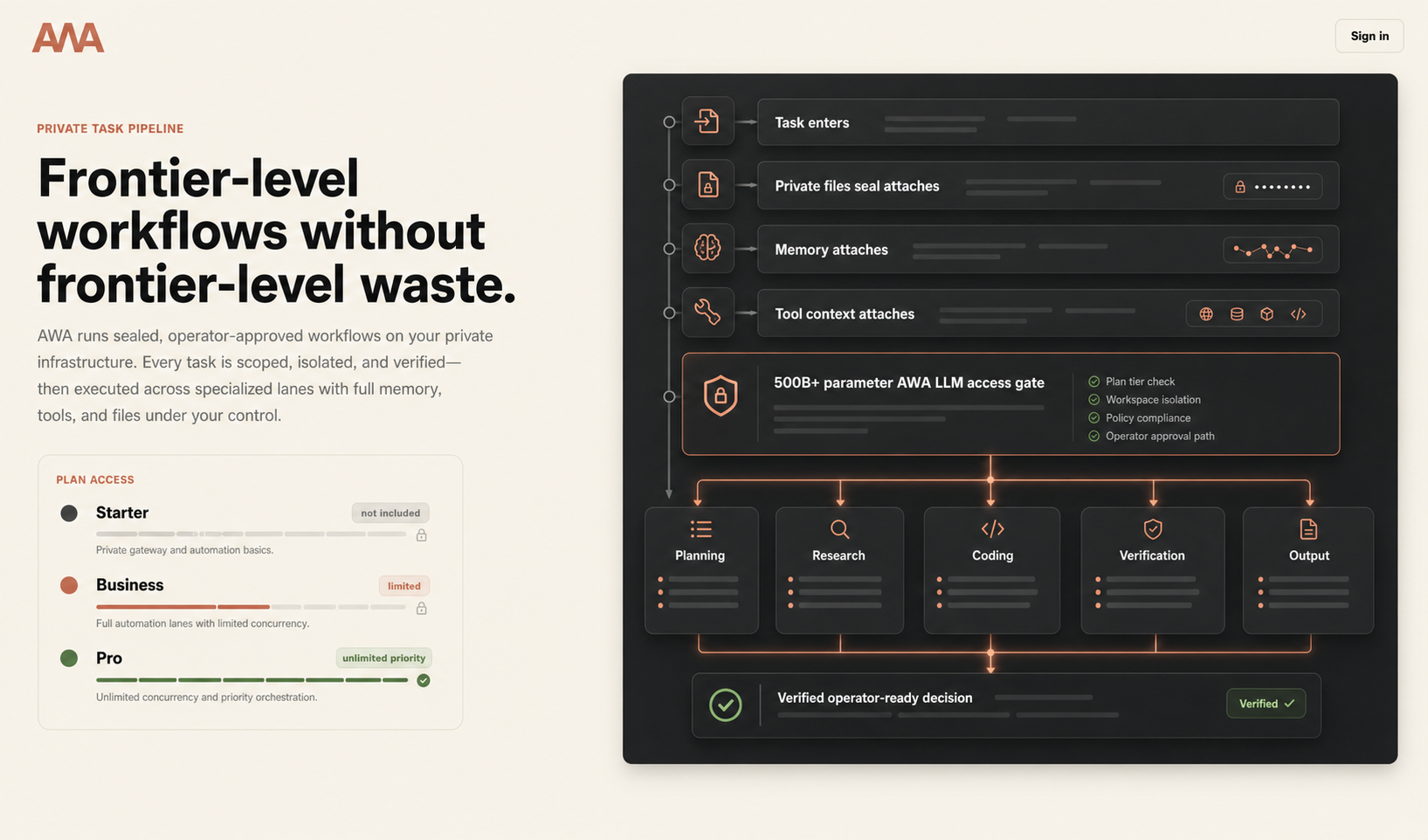
Access-meter idea only. Do not copy the render-heavy composition or weak right-side product object.
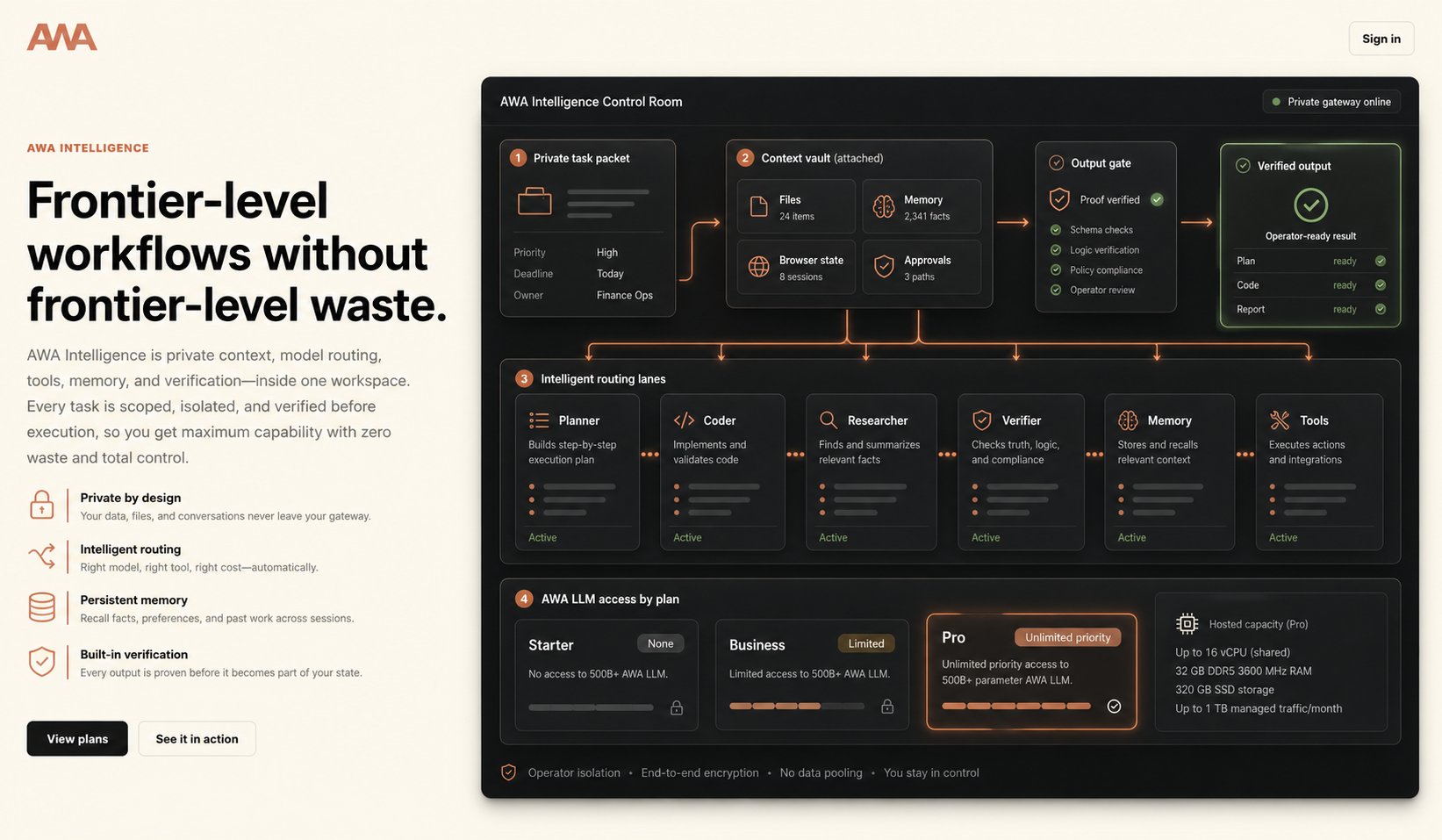
Use only for plan-access clarity. Correct all generated policy/spec text and redesign the visual language.
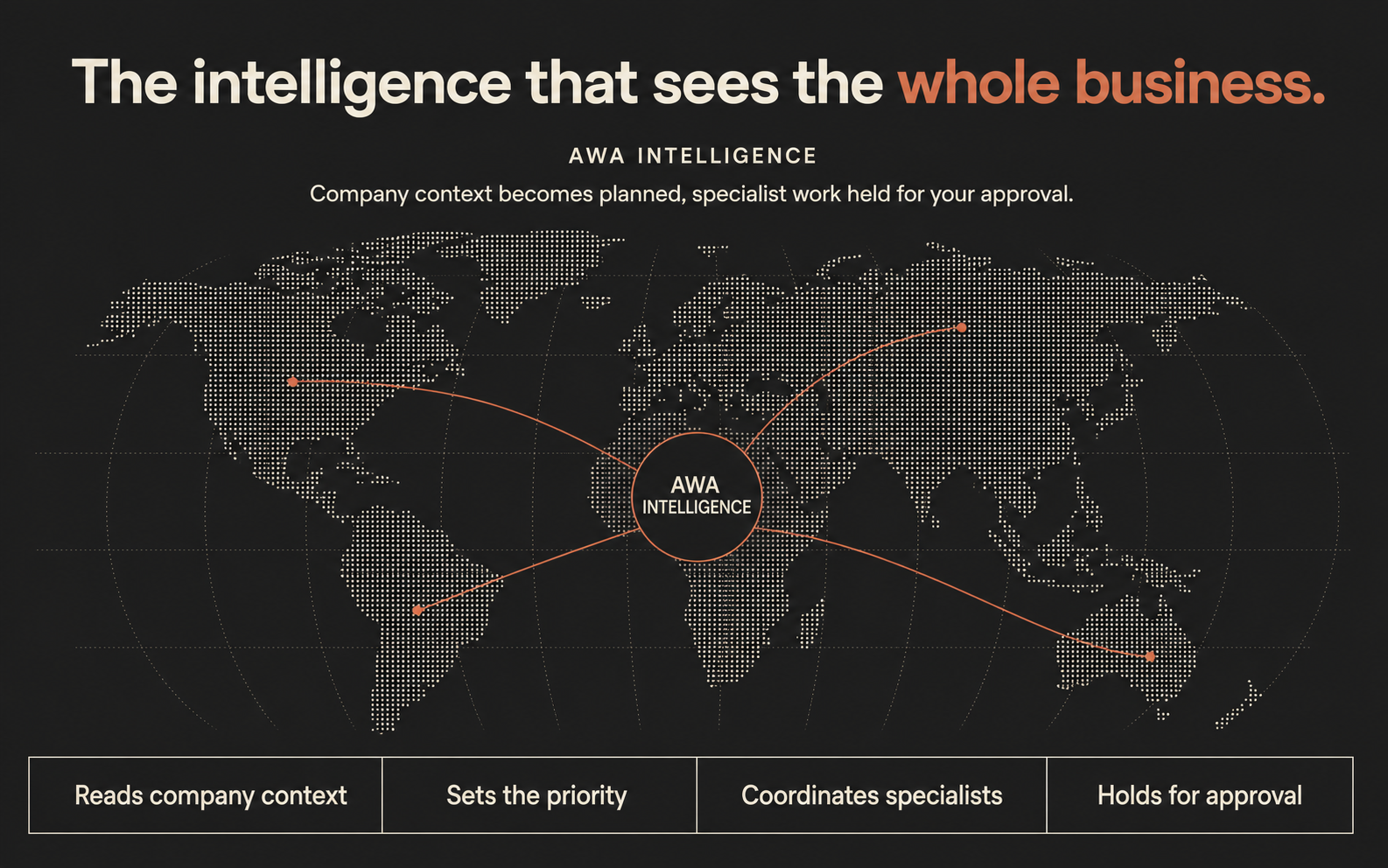
Dark global field that positions AWA Intelligence as the centre of company context, priorities, specialist work, and approval.
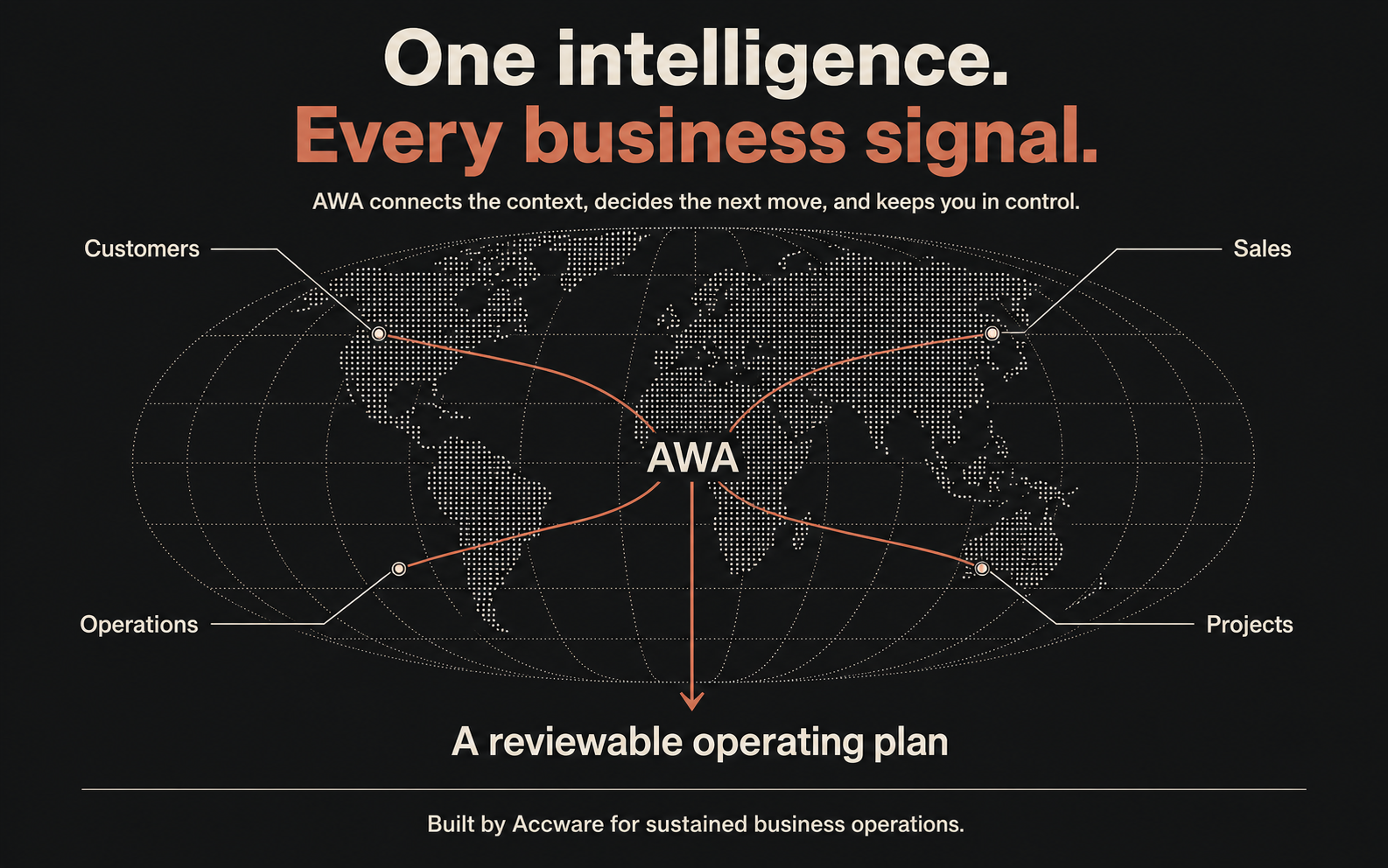
Dark global field showing customer, sales, operational, and project signals converging into a reviewable operating plan.
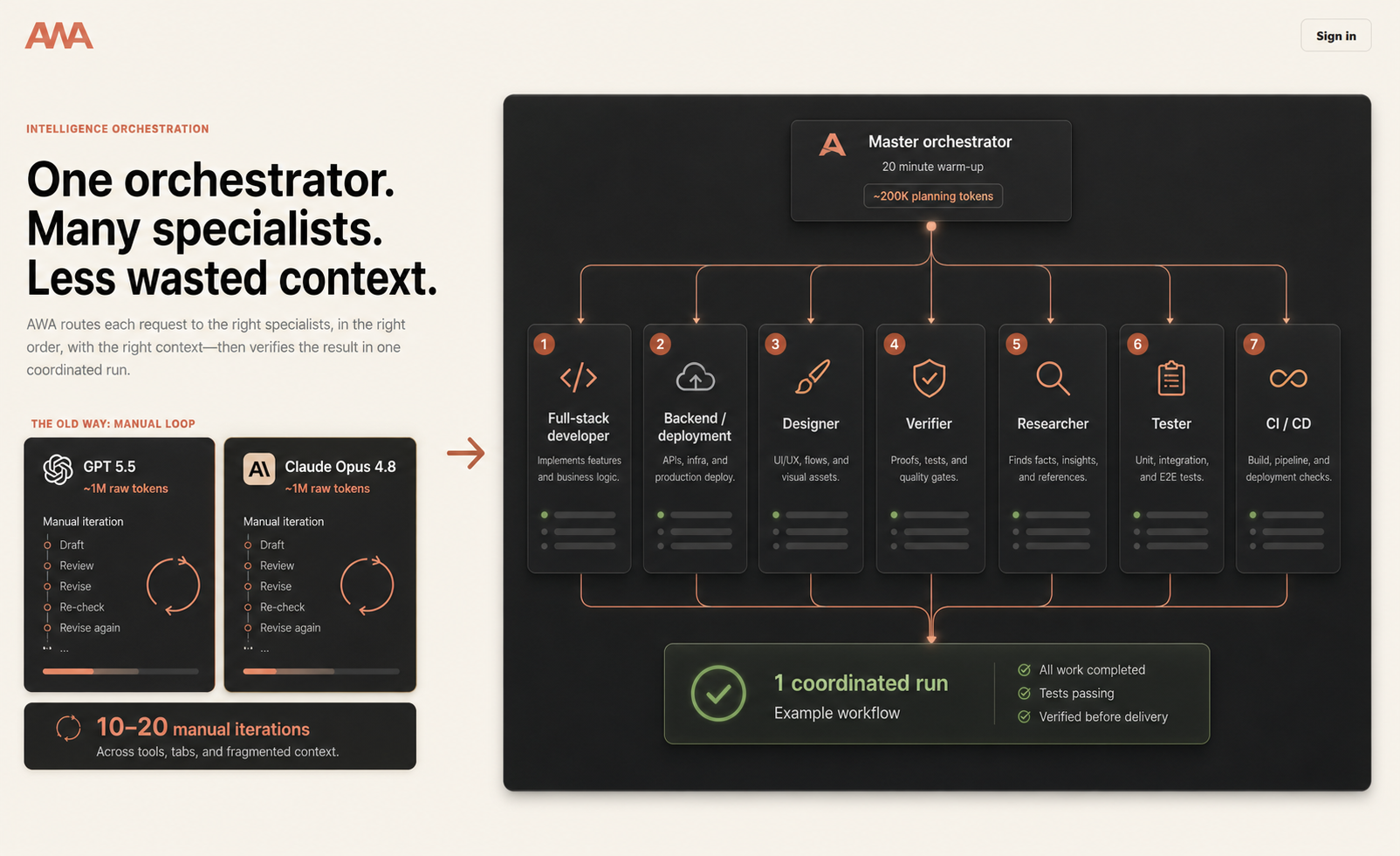
Borrow only the readable tree spacing. Rebuild labels around Fable 5, GPT 5.6 Solana, GPT 5.6 Tera, Luna, and AWA Intelligence.
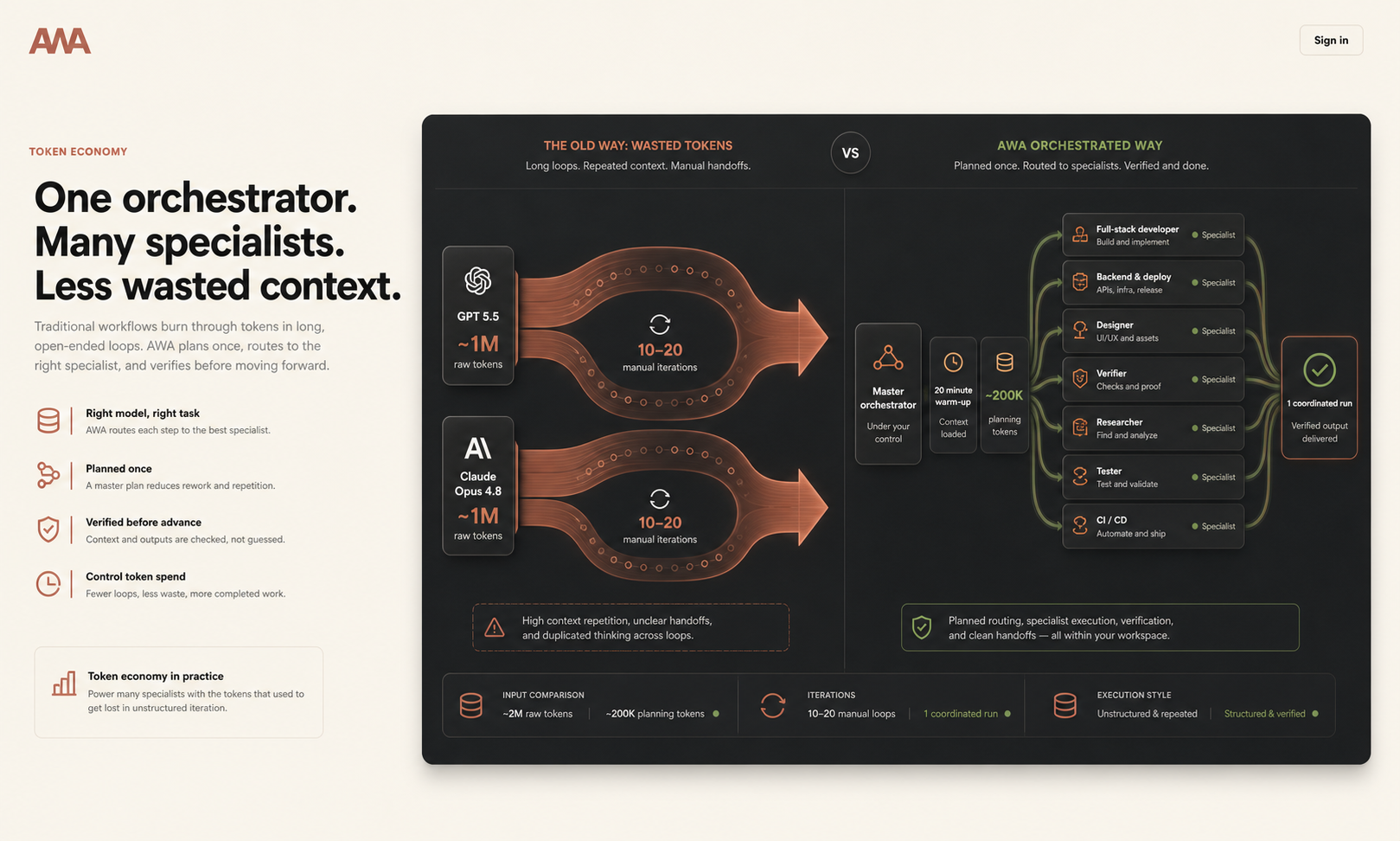
Token-flow metaphor only. The accepted direction must be a clear coordinated dispatch tree, not an abstract diagram.
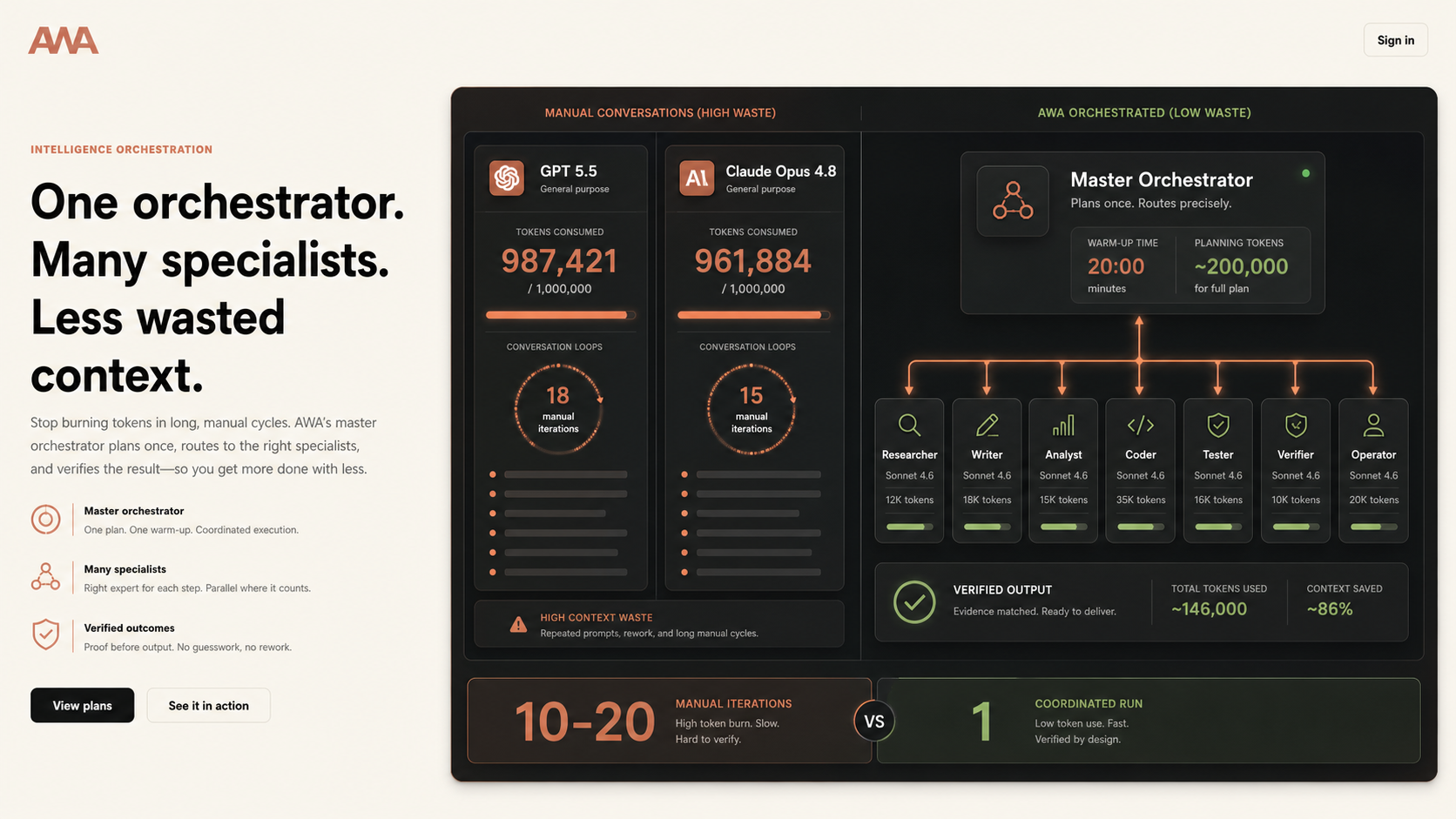
Borrow the strong `10-20 manual iterations` versus `1 orchestrated run` claim. Rebuild the model and verifier lanes.
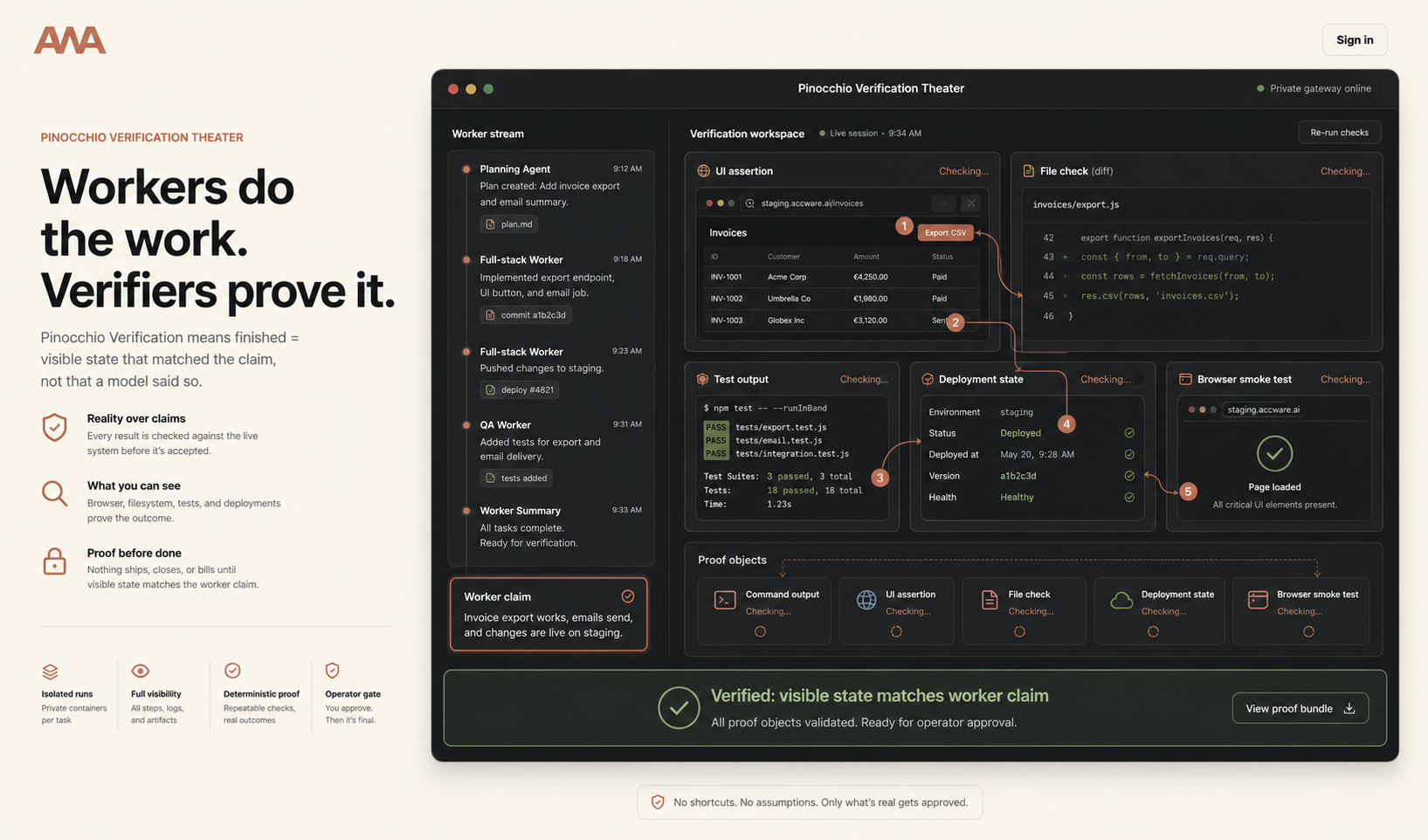
Proof sequence only. Final motion must show a real cursor-driven verification run, not static markers.
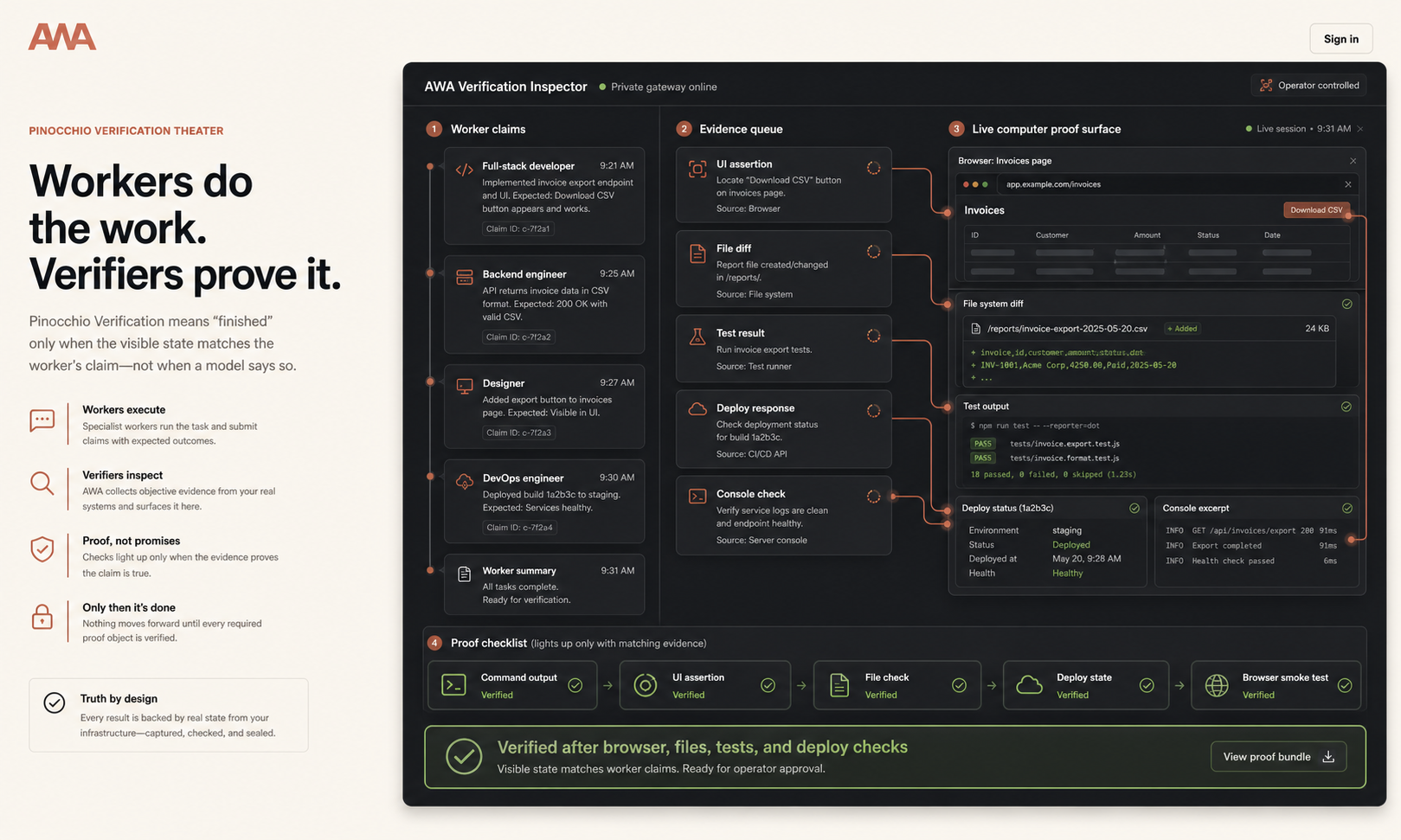
Evidence queue concept only. Avoid clutter and make each proof state visibly earned.
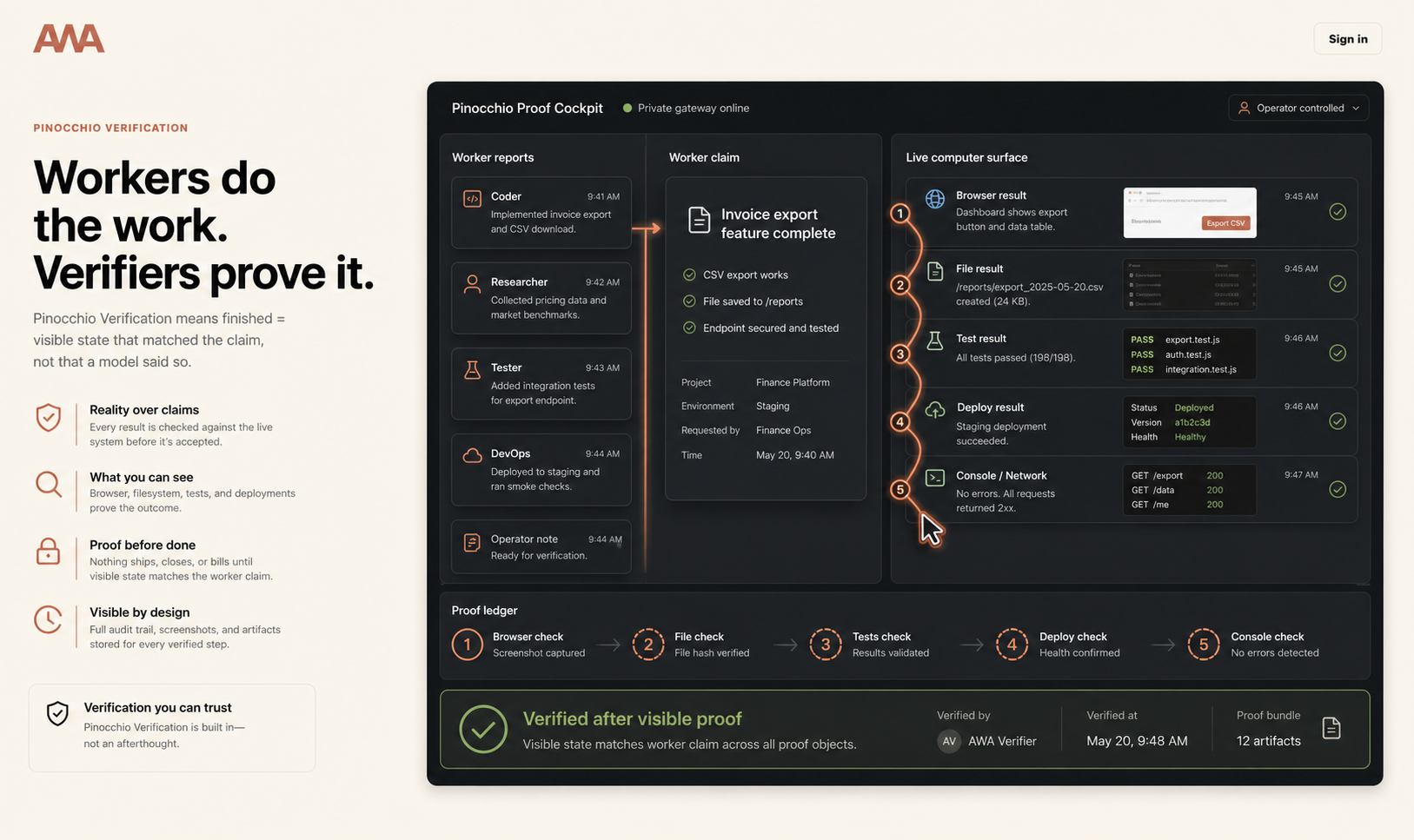
Use for mobile simplification and ordered proof badges after the desktop verification animation is solved.
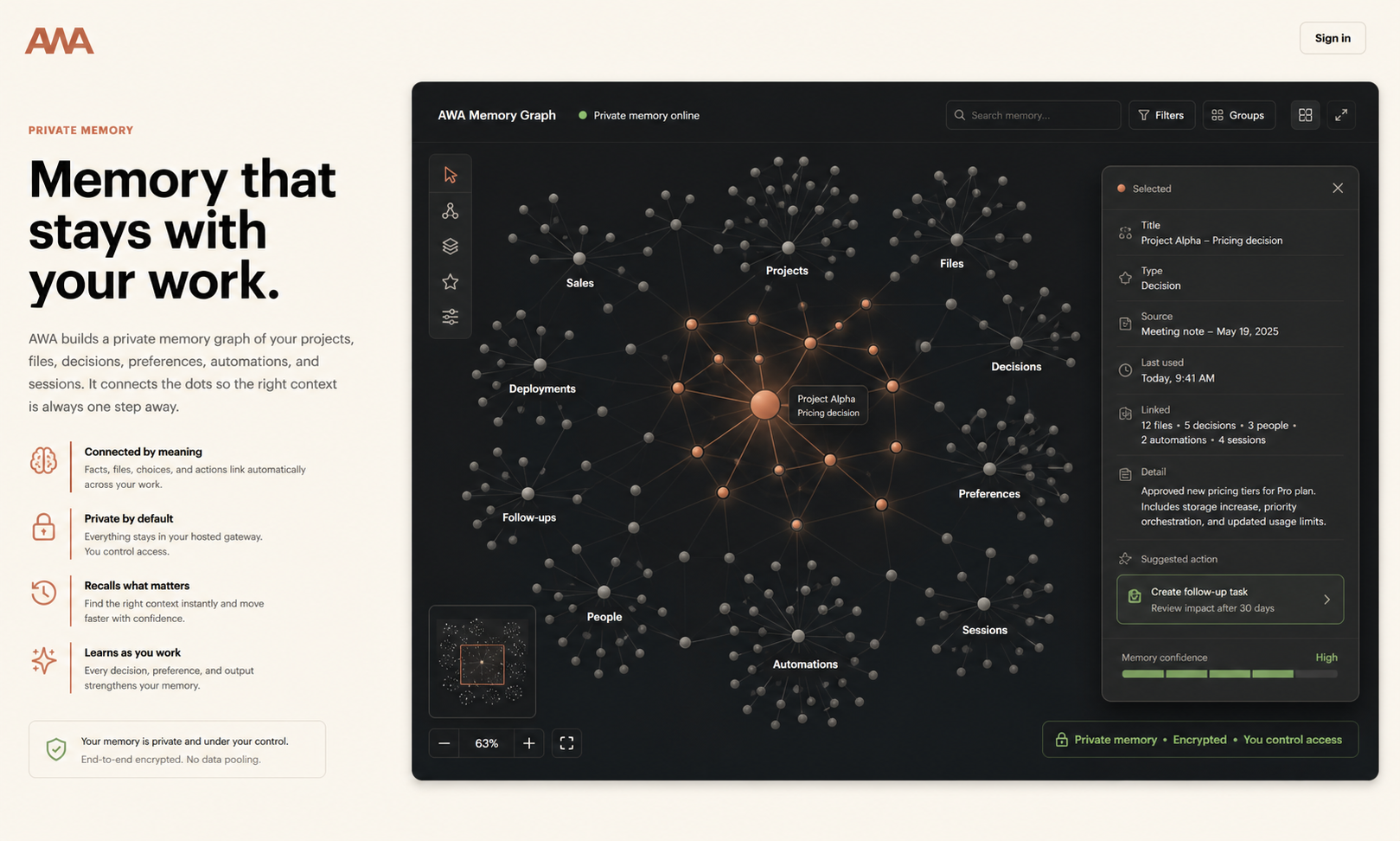
Do not implement yet. Revisit only after an actual real-system screenshot exists.
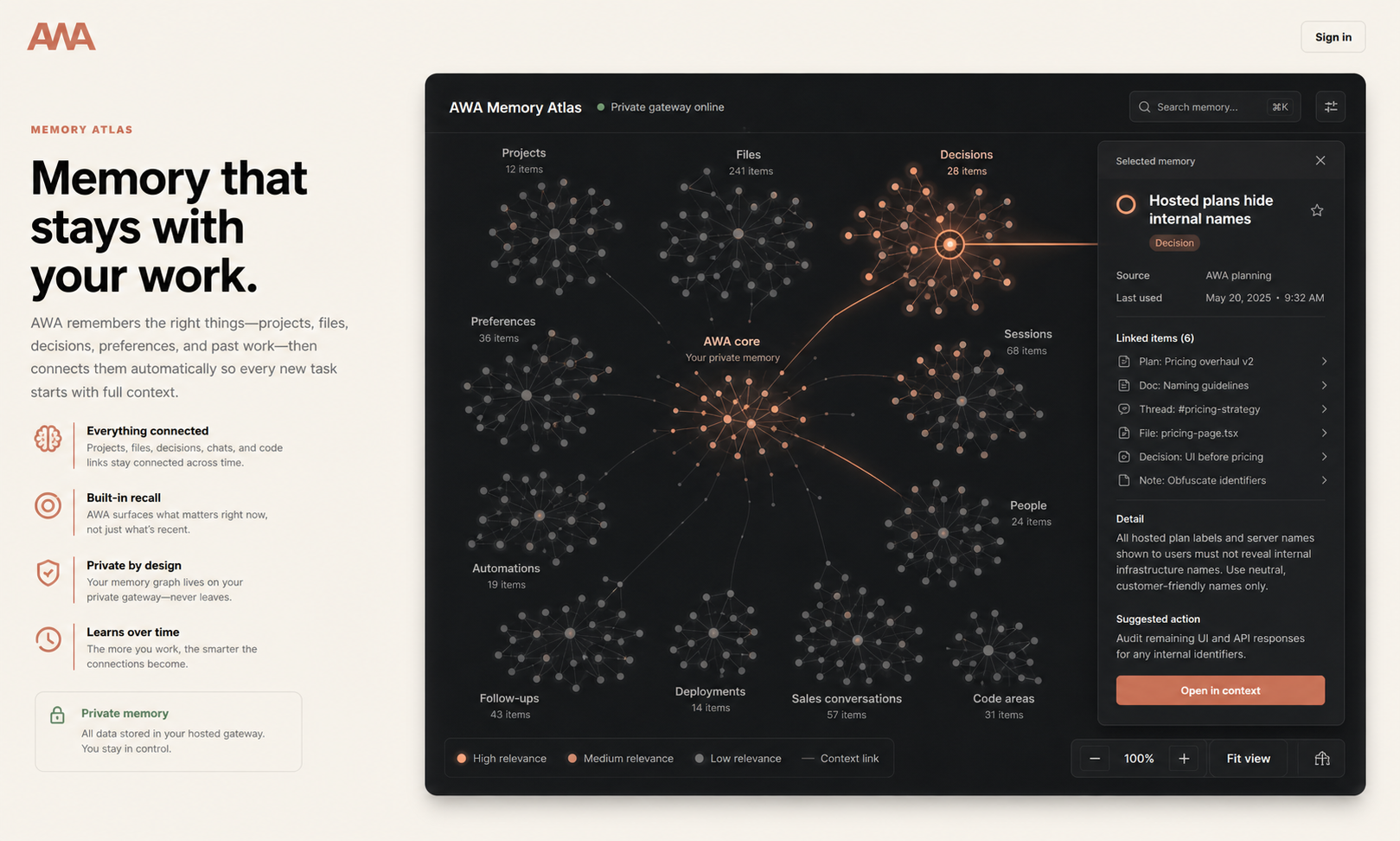
Do not use as approval. Future graph must follow the real system screenshot and Obsidian-like interaction.
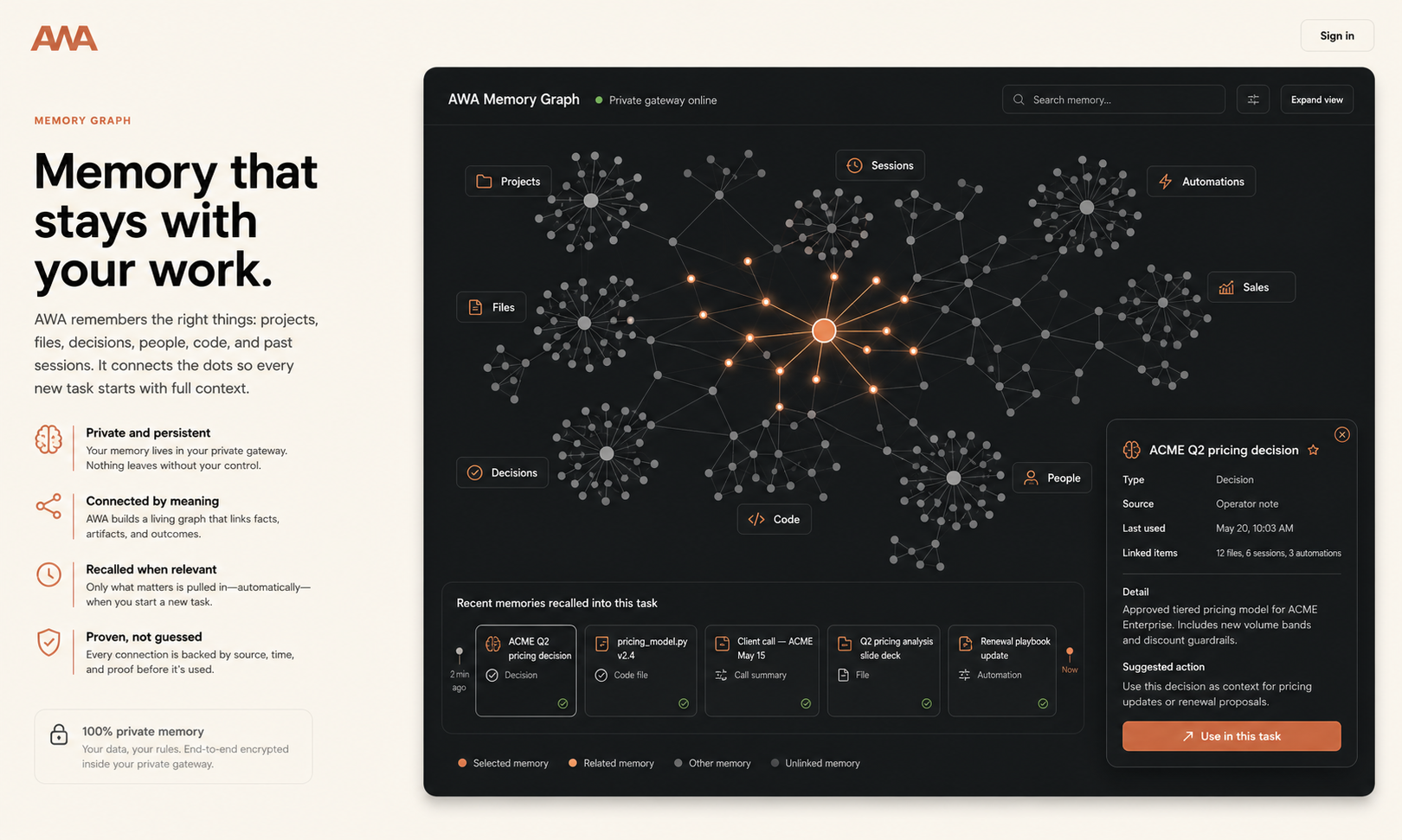
Optional idea only after the real graph direction is approved.
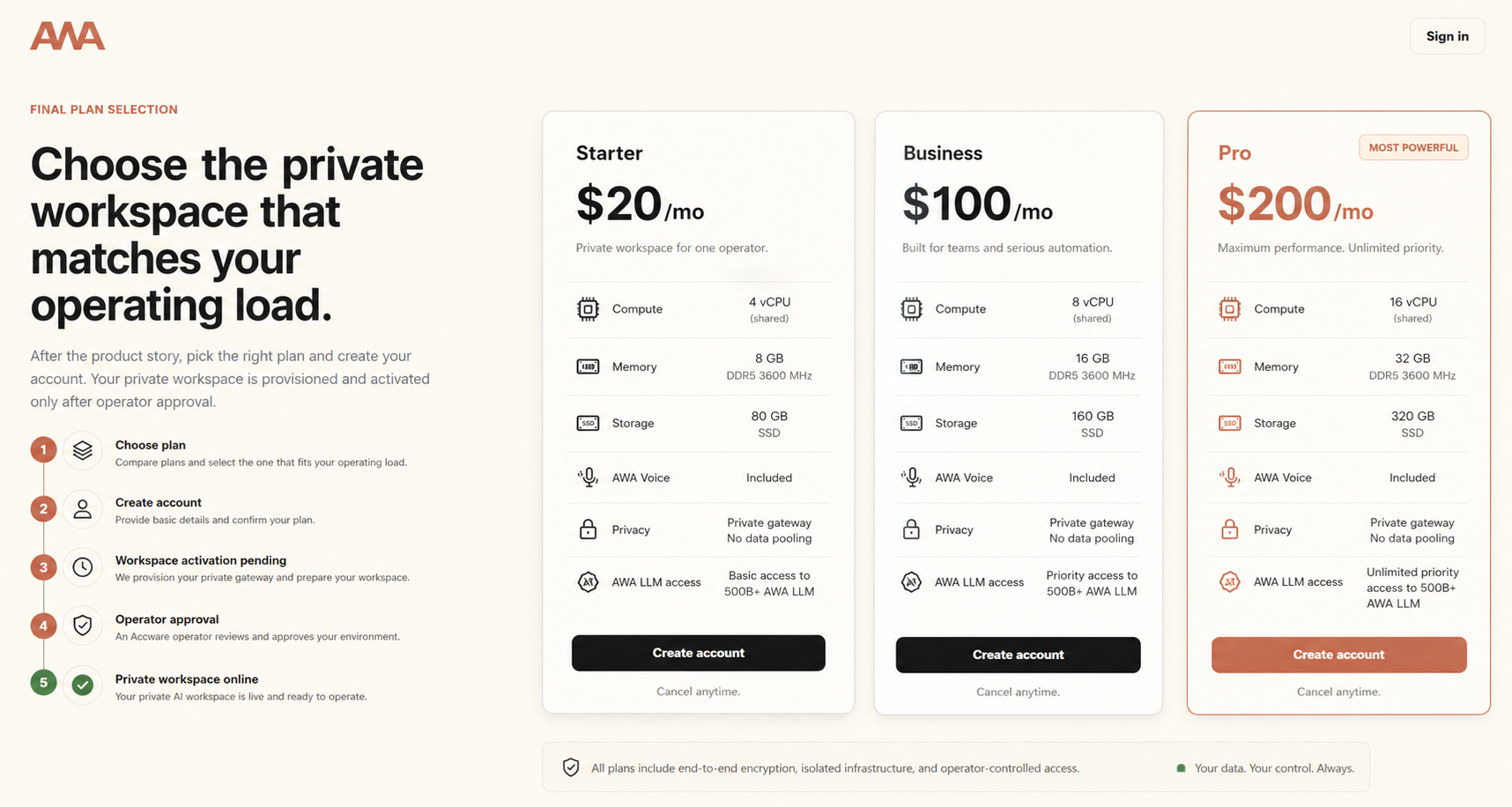
Do not repeat plan cards or pricing. Use only if it helps a fresh activation/account handoff story.
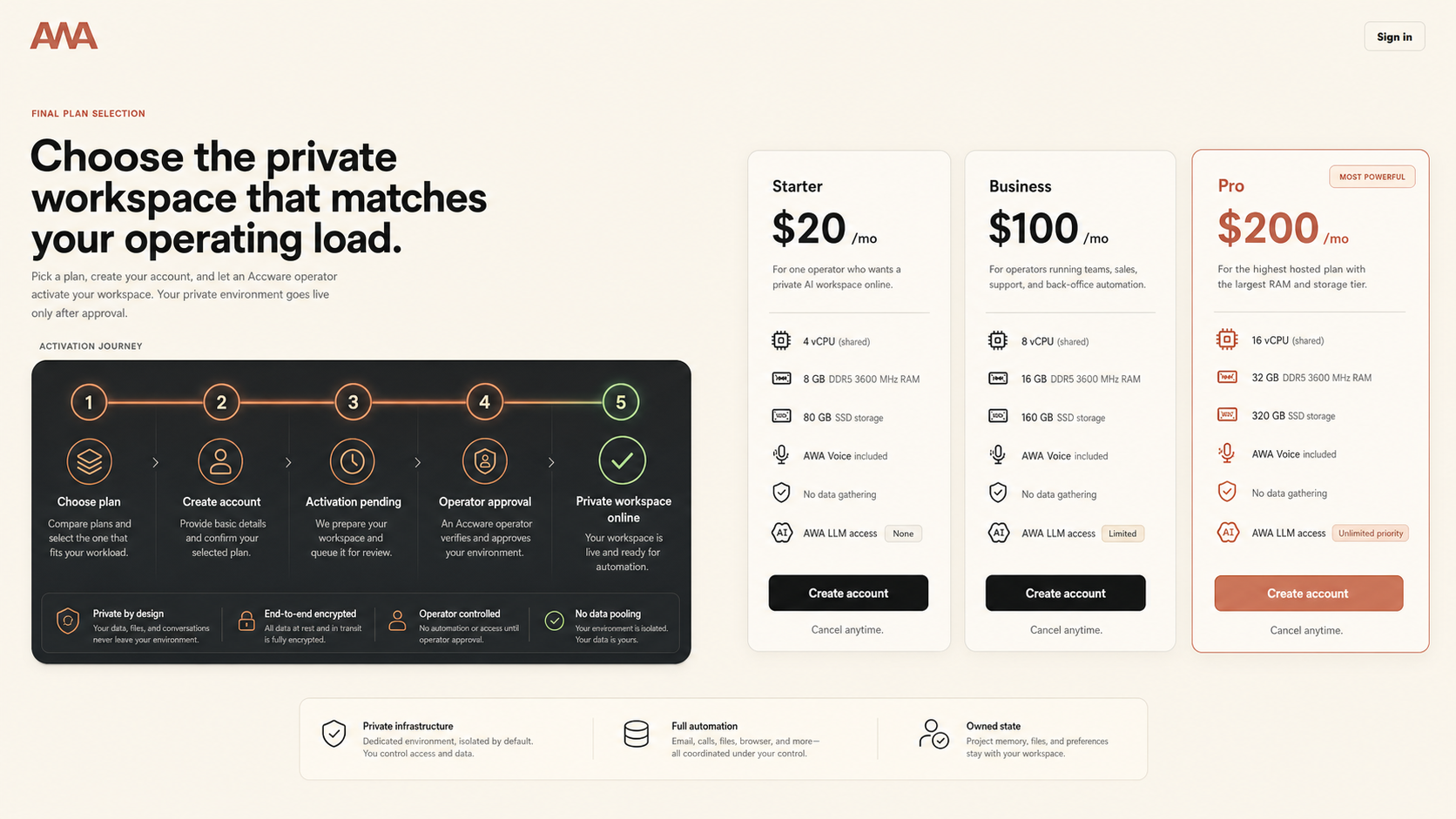
Journey object is the only useful idea. The next concept must avoid Section 2 duplication.
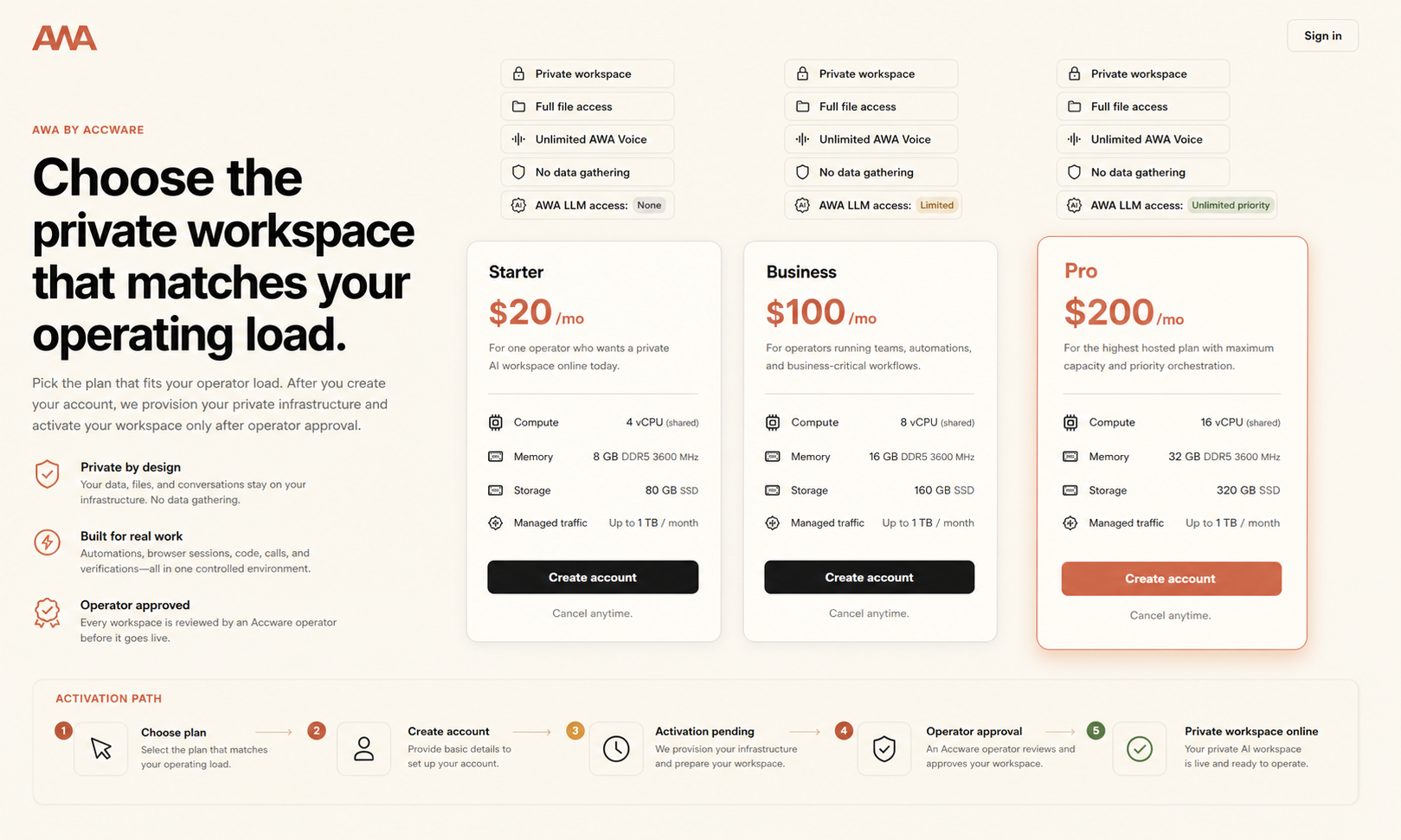
Hierarchy reference only. Rebuild around activation, sign-in, and account handoff without pricing clutter.
Implementation contract
Generated PNGs frequently contain wrong microcopy. The live site must follow `AWA_LANDING_VISUAL_LOCK.md` and `AWA_LANDING_AUTONOMY_EXECUTION.md` for final language, routes, specs, and behavior.
Use exact product copy in source. Never trust generated text pixels for specs, plan policy, routes, or claims.
Every section needs a believable product object: workspace, carousel, switchboard, token tree, verifier, memory graph, activation console.
Animate routing, consolidation, proof, memory selection, token counts, and activation. Do not add idle technical noise.
No-slop gate